Maintenance & Prevention
How to Clean a U-Line Ice Machine, Including the Nugget
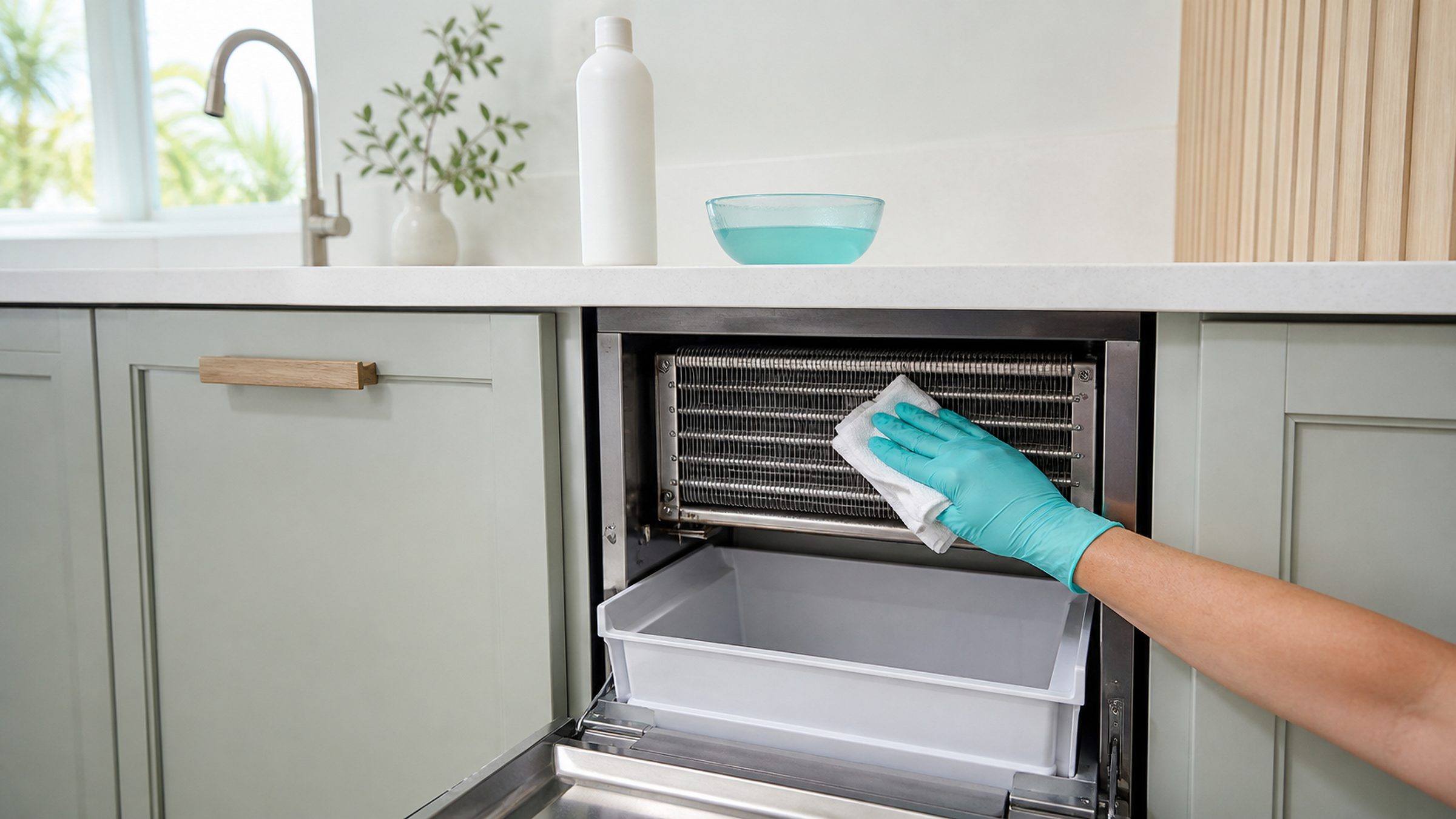
Put the machine into clean mode by holding the clean key for several seconds, add U-Line's own ice machine cleaner as the manual directs, and let it run: it cleans, drains and refills repeatedly for about ten minutes on its own. Then clean the inside of the reservoir by hand with a sponge and the remaining solution, and rinse with clean water, pouring some through the ice spout. Discard the first batch of ice afterwards. Two rules are not negotiable. Use the maker's own ice machine cleaner and nothing else — the manual says other cleaners can damage the machine, and on a nugget machine the chemical reaches the auger and the evaporator. And do not skip the signal: after six cumulative months of ice making, the ice, no water and drain lamps each flicker twice in turn and keep doing it until the cycle is run. In South Florida, six months is an optimistic interval rather than a generous one.
The full guide
How to clean u line ice maker: the machine asks, and it does not stop asking
U-Line builds the reminder into the control. From the manual for the nugget machines:
> After cumulative 6 months of ice making, the machine will signal that is time to run a cleaning cycle. On the display, the ice, no water, and drain lamps each flicker twice sequentially. The flickering lights continue until the machine's cleaning function is performed.
Three lamps, flickering twice each in turn, over and over. It is not an error, nothing has failed, and nothing else on the machine looks like it. It is also very easy to live with for a year, which is how most of the machines we open have been treated.
The sequence
Empty the bin first. Whatever is in there is going in the sink at the end anyway.
Enter clean mode. Hold the clean key for several seconds. On the models that have a dedicated clean button it is marked; on the others it is the same key that toggles zones. Add the cleaner as the manual for your model directs.
Let it run. The machine cleans, drains and refills repeatedly for roughly ten minutes without any help. This is the part people interrupt, and interrupting it means starting again.
Do the reservoir by hand. Sponge or cloth, using the solution that is left. The automatic cycle circulates; it does not scrub, and the reservoir is where the film is.
Rinse properly. Clean water through the system, and pour some down the ice spout as well — the spout is outside the circulating path and it is the last thing the ice touches.
Throw the first batch away. Every time. This is the step that gets skipped and it is the one everybody notices.
Why the maker's own cleaner, specifically
The manual says other cleaners can cause damage, and on this equipment that is a mechanical statement rather than a commercial one.
A nugget machine circulates whatever you put into it past an auger, a freezing cylinder, a set of seals and a water pump. A clear ice machine circulates it past a dispense valve, a circulation pump and an inlet valve. Household descalers are formulated for kettles and shower heads, not for a food-contact machine with driven components and elastomer seals in the loop.
Vinegar has a place on a door gasket. It does not have one here.
Six months is optimistic in South Florida
The interval assumes ordinary water. What comes out of the tap across Miami-Dade, Broward and Palm Beach is harder than that, and scale does not arrive politely — it narrows every water path in the machine at the same time.
What it does, in order of how much it costs:
- The reservoir and the level sensing. Scale on a float or a probe makes the machine misjudge how much water it has, which shows up as short fills, overfills, or a machine that stops for no visible reason.
- The evaporator surface. Scale insulates. Ice takes longer to form, comes out cloudy or thin, and production drops before anything stops.
- The auger and the cylinder, on a nugget machine. Abrasive deposits between a driven screw and the wall it runs against. This is where an ignored cleaning signal turns into a gearbox.
- The drain. Narrowed the same way everything else is, which is how a cleaning problem becomes a water-on-the-floor problem.
A practical rule for this climate: if the machine visibly scales between cycles, it wants a filter as well as a schedule. That is a recommendation rather than a rule, and it is worth asking about at the end of a visit.
What cleaning will not fix
- A machine that stopped because the water stopped. Check the shut-off valve, the filter and the line first; a cleaning cycle on a machine with no water supply will not complete.
- An auger that has already jammed. That is a repair, and running a cycle against it does not help.
- Ice that has fused into a block in the bin. That is usually a household that is not using much ice, not a dirty machine.
The unglamorous point
Descaling is the cheapest thing on this entire site and it prevents the most expensive. A nugget machine's auger, gearbox and cylinder assembly is the largest single ice-machine bill there is, and the most reliable way to arrive at it is to ignore three lamps flickering for a year.
If it turns out to be a repair
What this leads to, and what it costs
Every job on this site is priced the same way: an on-site diagnostic first, the figure agreed in writing before anybody starts.
-
Ice machine cleaning and descaling
The cheapest service on this site and the one that prevents the most expensive. U-Line signals for a cleaning cycle every six cumulative months of ice making and is explicit that only its own ice machine cleaner may be used. In South Florida that six-month interval is optimistic: scale is what ends ice machines here, and it does it quietly.
- The maker's own cleaner, because the manual says so
- The full cycle, then a rinse — not a wipe
- An interval set to your water, not to the calendar
-
U-Line: Three lamps on the ice machine flicker twice, over and over
U-Line — an indicator rather than a code. The machine is asking to be cleaned.
What the machine is telling you -
Ice maker not making ice
The most searched thing about this make by a wide margin. Almost every cause is on the water side rather than the cold side, and the first three checks cost nothing and are the answer more often than everything else put together.
- Stopped completely
- Making less and less over weeks
- Freezing water but never dropping it
-
Water inlet valve and supply repair
Everything between the shut-off and the reservoir. The maker's own indicator for it says four words — lights up to indicate low water supply — so the work is finding which link in the chain is short. These machines mind flow rather than pressure, which is why a filter at the end of its life starves one slowly enough that nothing ever looks wrong.
- Flow measured, not assumed from the tap
- Filter age treated as a real variable
- The line checked for the kink a reinstall leaves
Questions people ask about this
How do I know when my U-Line ice machine needs cleaning?
It tells you. After six cumulative months of ice making, the ice, no water and drain lamps each flicker twice sequentially, and the flickering continues until the cleaning function is performed. It is a reminder on a timer rather than a failure, and ignoring it long enough turns it into one.
Can I use vinegar instead of the ice machine cleaner?
The manual warns that other cleaners can damage the machine, and this is one of the places where that warning is worth taking literally rather than as a way of selling consumables. A nugget machine circulates whatever you put in it past the auger, the evaporator and the seals. Vinegar is fine on a gasket and is not what the maker specifies here.
How do I reset the machine after cleaning?
You should not need to. The cycle completes and the machine returns to making ice. If it sits idle afterwards, check that water is arriving — a machine that was drained and has not refilled looks reset when it is actually waiting on a closed valve or a slow filter.
How long does the whole thing take?
The automatic part is about ten minutes. Realistically, plan on the machine being out of use for an afternoon: the cycle, the reservoir by hand, the rinse, and then a first batch of ice to throw away.
Do I need to descale as well as clean?
On this water, yes, and the maker's cleaner does both jobs — it is a descaler as much as a sanitizer. What it cannot do is undo scale that has been building for three years. A machine that has never had a cycle usually needs more than one.
Maintenance & Prevention
More guides like this one
-
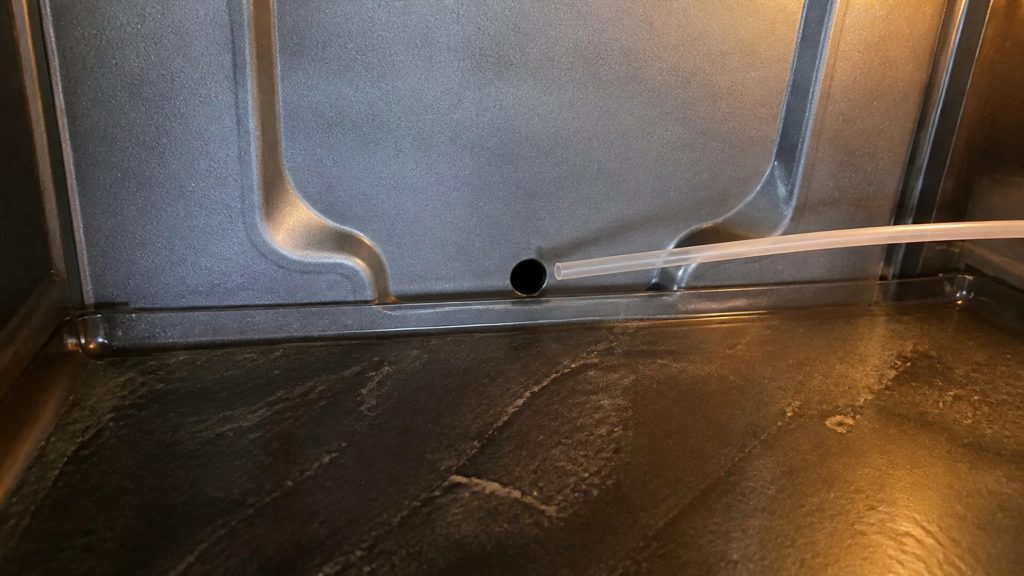
How to Clean a Refrigerator Drain Line Before It Reaches Your Cabinetry
On a built-in appliance a blocked drain does not make a puddle first. It puts water into the carcase and the floor, and by the time anything shows, the joinery has been wet for a while.
Read more -
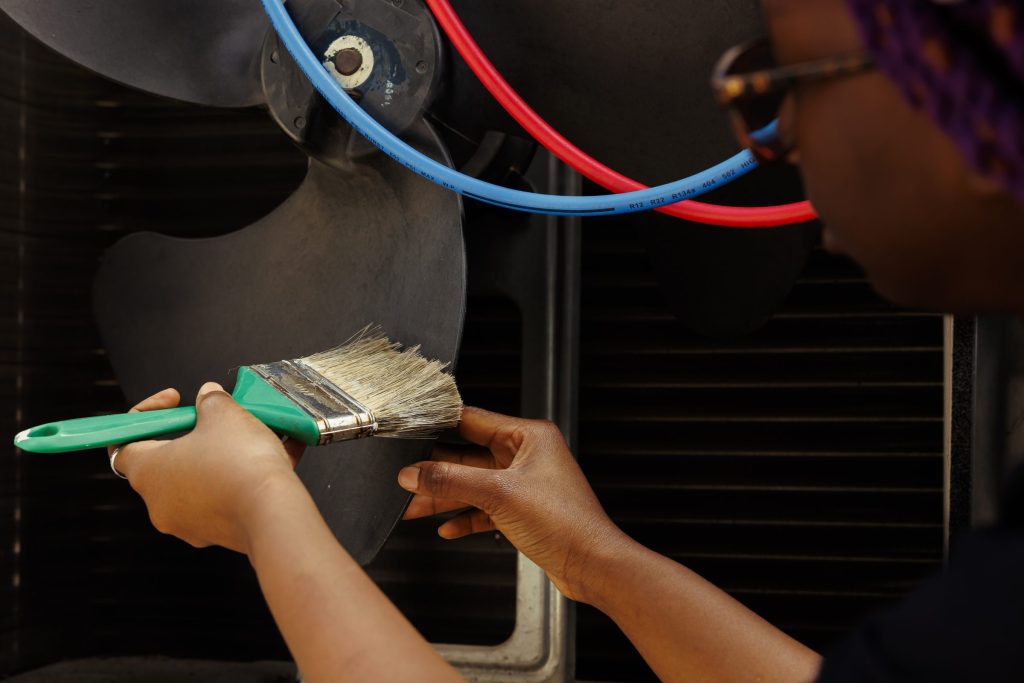
Behind the Grille: Cleaning the Condenser and the Drain Pan
Two things live behind the grille at the bottom of an undercounter unit, and both are worth ten minutes. One is the maker's own first answer for a cabinet that is not cold enough.
Read more -
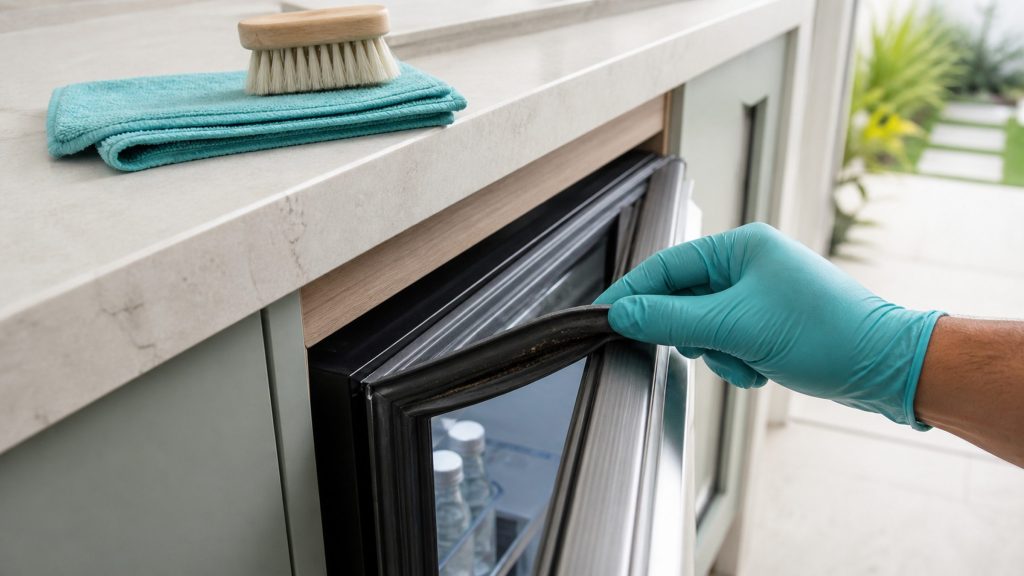
How to Clean a Refrigerator Door Gasket — and the Test That Follows
Cleaning takes five minutes. The part that tells you whether the seal still works takes ten seconds and a sheet of paper — and on an undercounter cabinet in this climate it matters more than most people think.
Read more
Tell us the model number and what it is doing.
This article is based on:
- Official manufacturer documentation
- Internal repair procedures
- Technician repair history
- Company quality standards