U-LineRepair Miami

22 behaviors · and several of them are settings

What your U-Line is doing, and what it actually means.

No ice. Not cold enough. Beeping every minute. A blank display on a cabinet that is still running. Numbers flashing on an ice machine. This make hides most of its errors in a log nobody can see, so what you can observe is worth more here than on almost any other appliance — and a real share of it is the appliance working as designed.

  • 22 behaviors described here
  • 11 documented signals, quoted from the manual
  • 1 error the E platform ever displays
  • from $95 diagnostic, credited to the repair

Start from what it is doing

Described the way you would describe it on the phone

Not "sealed system failure" but "it runs and never gets cold". Each page names the free checks first, then what it usually turns out to be, then the repair that answers it.

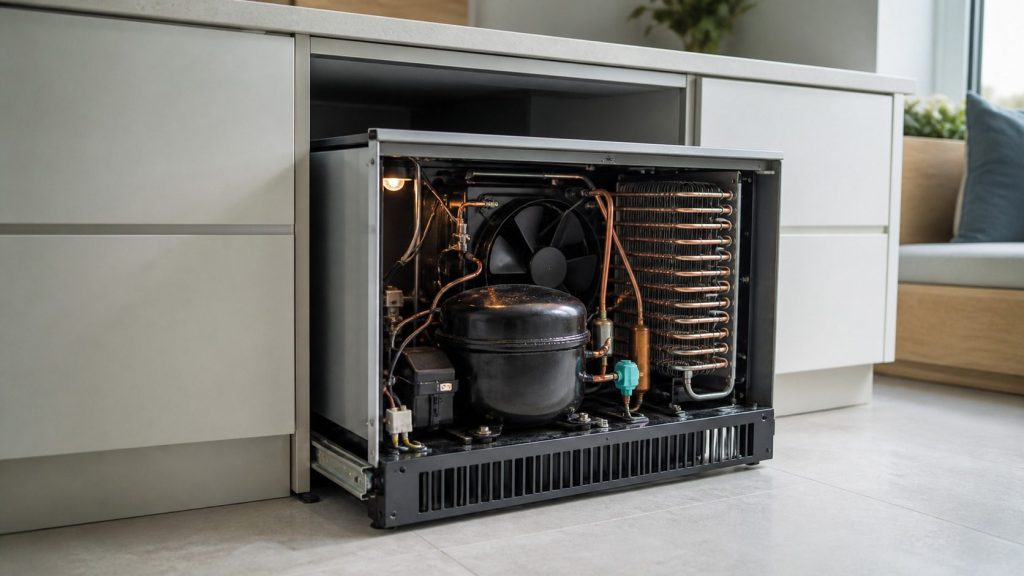
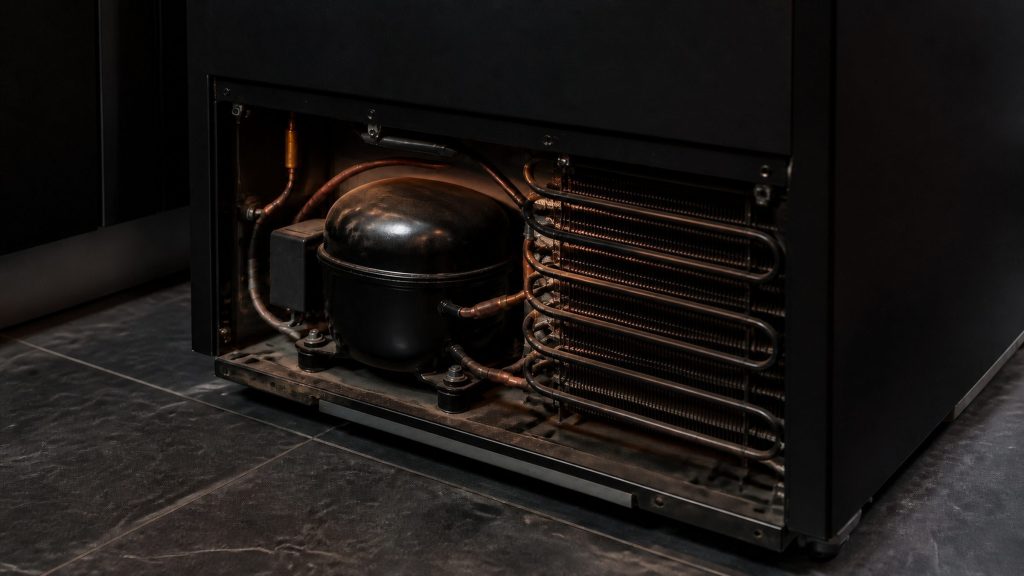
  • A refrigeration compressor and condenser tubing at the back of a cabinet, warm from running, seen in a dim service light with the cabinet pulled forward
    It hums, it lights up, and nothing is cold

    Not cooling but still running

    The most common call on this make and the one with the cheapest answer hiding inside it. Before anything is opened, two modes have to be ruled out — one of them lights the display, works the light and deliberately stops the refrigeration.

    • Running, lit, and warm inside
    • Started after a move or a delivery
    • Everything looks normal except the temperature
    What it usually means
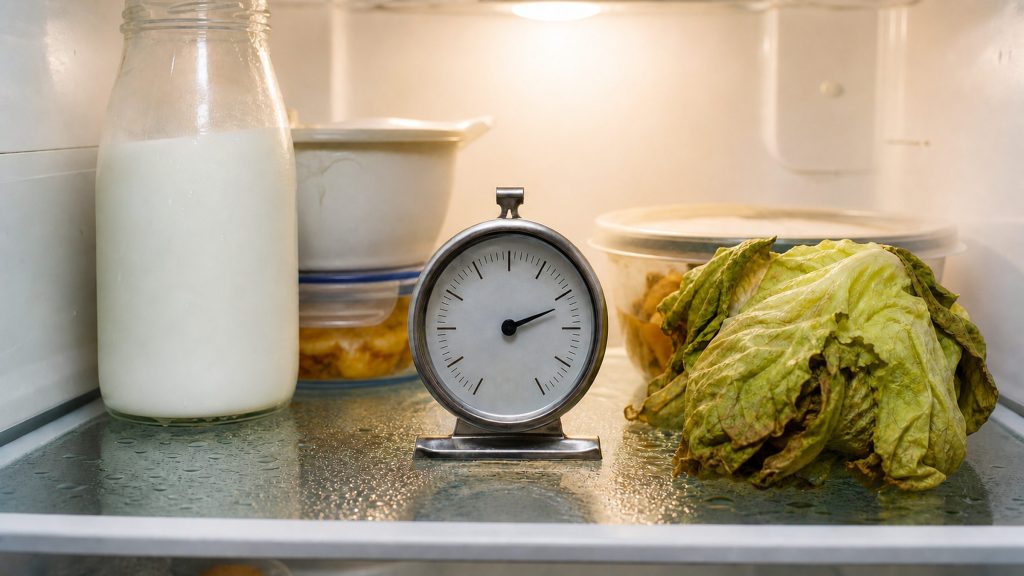
  • The lit interior of a refrigerator: a bottle of separated milk, covered dishes, a limp lettuce, a dial thermometer in the middle, water beaded on the shelf
    It works, but it never quite arrives

    Not cold enough

    A cabinet that is cold, but not at its set point, and never has been since something changed. On this make that pattern has a specific and documented cause that shows nothing on the display, which is why it gets lived with for months.

    • A few degrees out, all the time
    • Worse when the kitchen is warm
    • Runs longer than it used to
    What it usually means
  • A compressor and its condenser tubing in the machine compartment of an undercounter cabinet, seen in a dim service light with the unit pulled forward, the fan blade caught still and the metal warm from running.
    Ten minutes on, forty minutes off, over and over

    It cycles on and off in a strange rhythm

    This one is worth its own page because the rhythm is a diagnosis. U-Line publishes the numbers: when a zone sensor fails, a 2000 Series unit runs ten minutes on and forty minutes off, whatever the cabinet actually needs, and says nothing about it.

    • A fixed rhythm that ignores the load
    • Nothing on the display
    • Started suddenly rather than gradually
    What it usually means
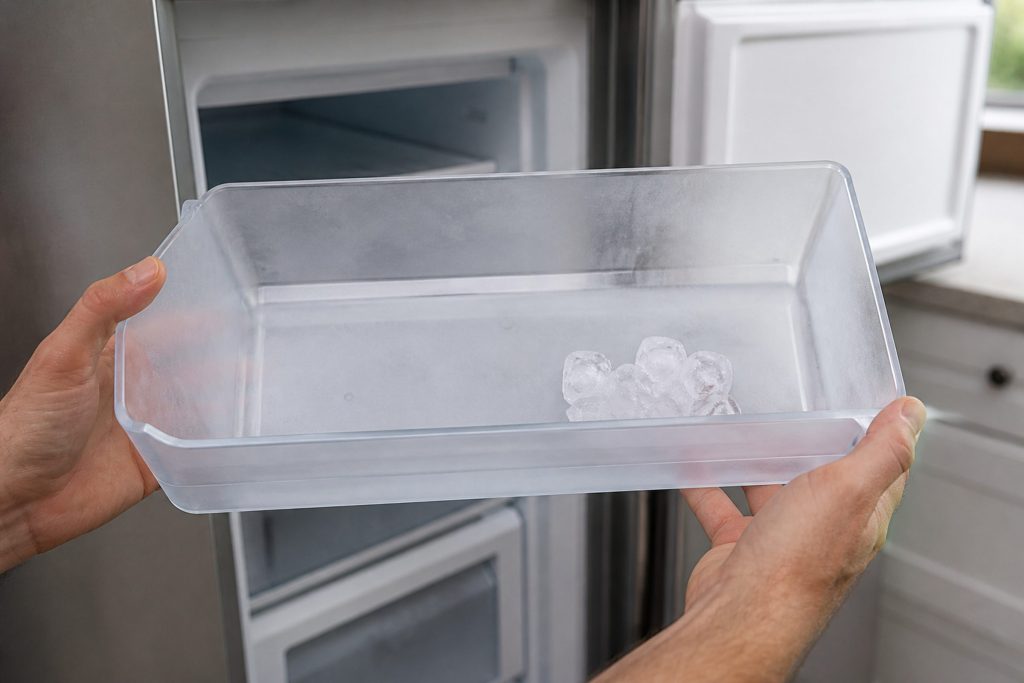
  • An empty ice bin pulled out and held level, a few loose cubes fused into a lump in one corner and the rest bare plastic
    Water in, harvest, water out — in that order

    Ice maker not making ice

    The most searched thing about this make by a wide margin. Almost every cause is on the water side rather than the cold side, and the first three checks cost nothing and are the answer more often than everything else put together.

    • Stopped completely
    • Making less and less over weeks
    • Freezing water but never dropping it
    What it usually means
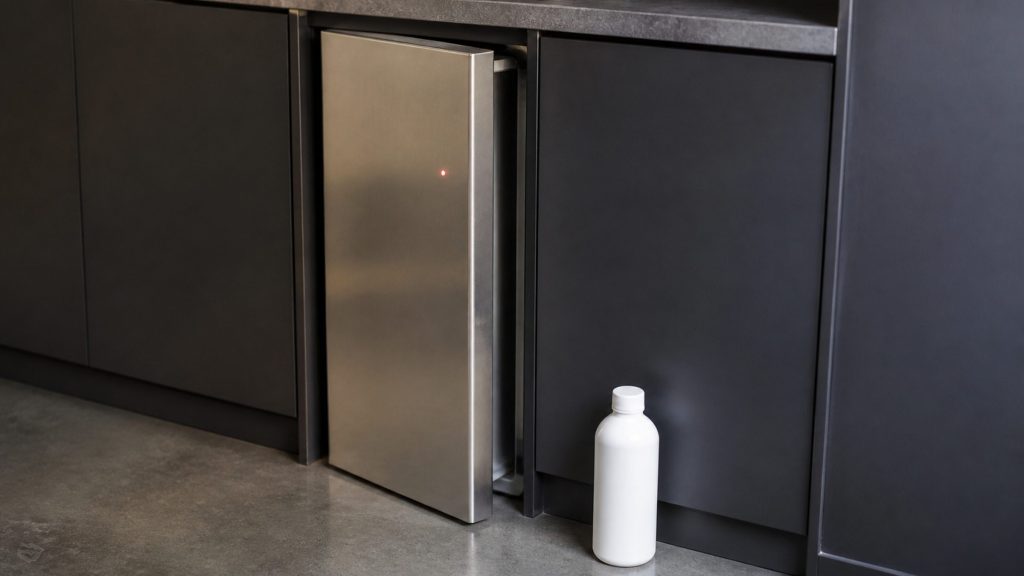
  • A narrow stainless door ajar in dark cabinetry with one small red light on the blank fascia, a plain white bottle on the floor beside it
    Nothing on the panel, or nothing after it

    Ice maker will not turn on

    A machine that shows no sign of life is a power question before it is a repair, and the maker publishes the order to ask it in. Two of the four checks need nothing but a screwdriver and none of them involves a part.

    • Dark panel
    • Panel lit but nothing happens
    • Started after a power cut
    What it usually means
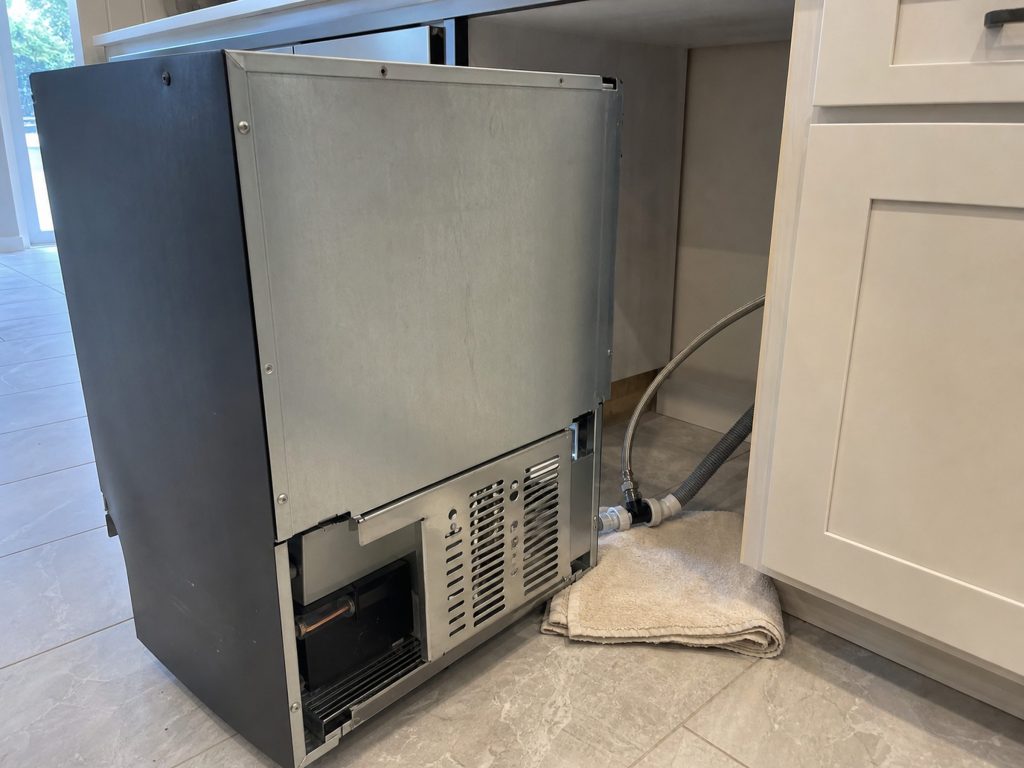
  • The back of an undercounter ice maker pulled forward on the floor, the water line and the drain pump hose visible behind it, a towel under the joint
    Where the water goes matters as much as where it comes from

    Ice maker not draining

    Standing water in the bin, water under the unit, or a machine that stops with a full reservoir. Half the diagnosis is a question nobody asks first: does this installation have a drain pump at all, or does it run to a gravity drain?

    • Water standing in the bin
    • Water on the floor under the unit
    • The drain lamp lit constantly
    What it usually means
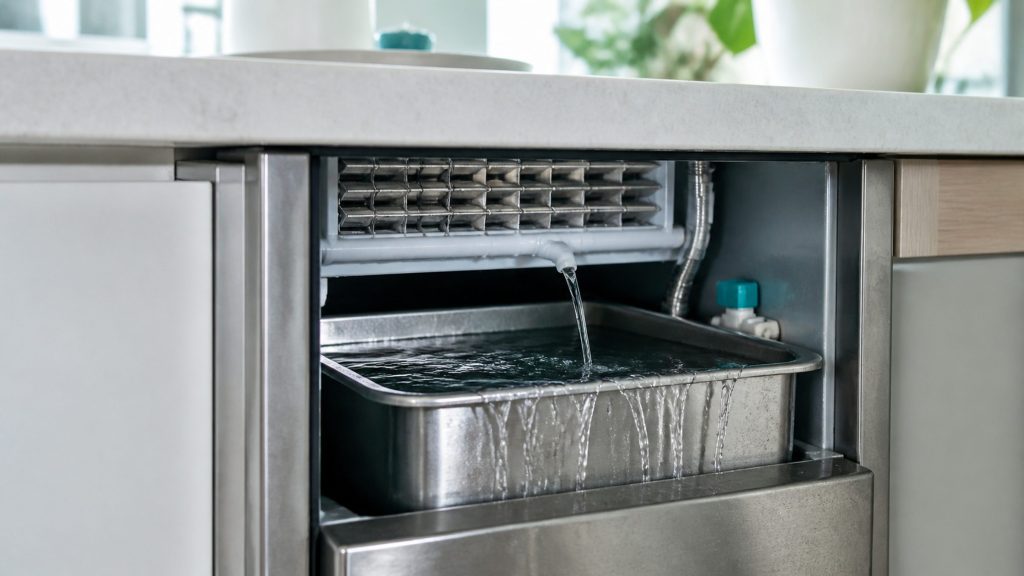
  • A thin clear stream of water running continuously into the overfull water trough of an ice machine and spilling over its lip, the evaporator grid above, cold light across the stainless.
    A fill that never ends

    The ice maker keeps taking water

    A machine that fills continuously, overflows, or keeps its inlet valve open is doing something with a short list of causes — and one of them will damage a kitchen faster than it damages the appliance, so it is worth acting on the same day.

    • Water running constantly
    • Overflowing the reservoir
    • Wet floor with the machine otherwise working
    What it usually means
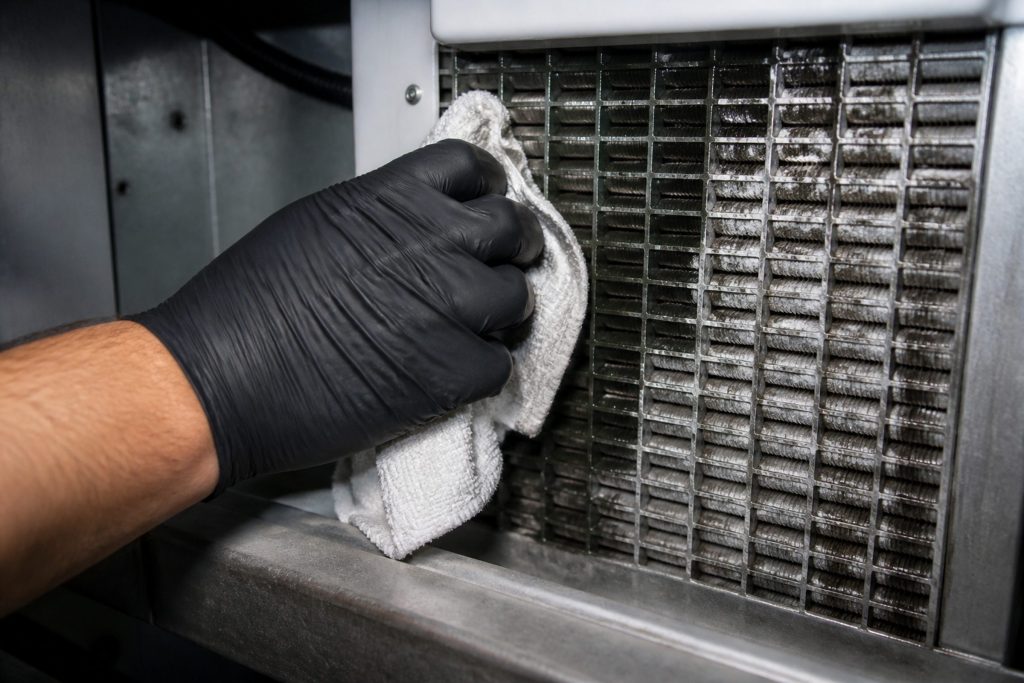
  • A gloved hand wiping a frosted evaporator plate inside a freezer compartment
    Ice where the machine did not intend it

    The ice maker is freezing up

    A block instead of cubes, ice bridging the mold, a bin frozen into one lump, or an evaporator growing a coat. Different machines fail this way for different reasons, and the shape of the ice is the clue.

    • A solid block instead of cubes
    • Ice bridging across the mold
    • Frost building where there was none
    What it usually means
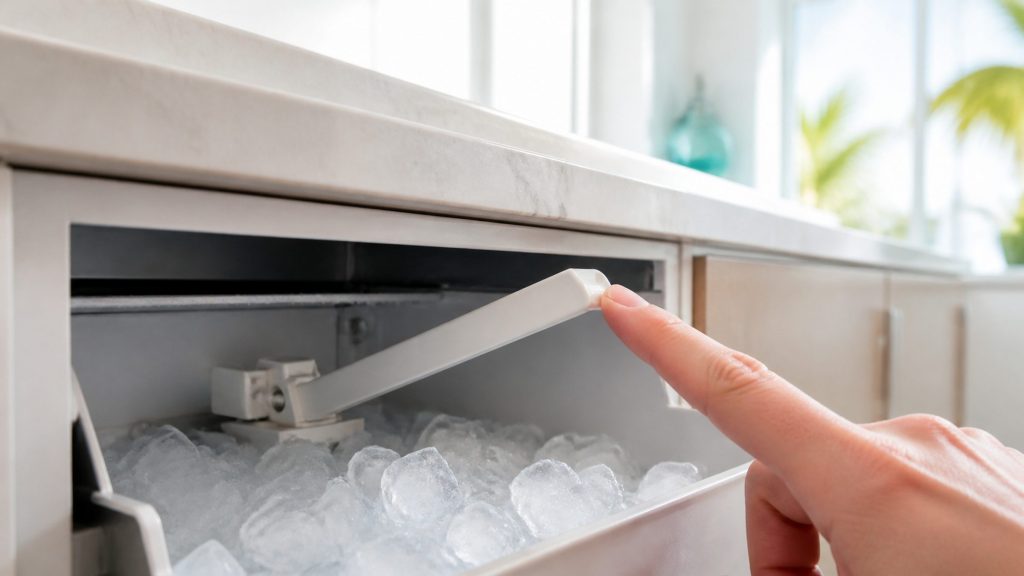
  • A close view of the white plastic bin-level sensor arm of an ice maker standing raised at an angle above a part-filled bin of cubes, a fingertip just touching it, shallow focus.
    Told it is full when it is empty

    The ice maker arm will not stay down

    One of the most searched things about U-Line's crescent makers, and it is not a metaphor: the bin arm is how a mechanical ice maker knows to stop. An arm that rests up is a machine that has been told the bin is full, and it will sit there indefinitely being perfectly healthy.

    • The arm rests in the up position
    • No ice, no error, no noise
    • Started after the bin was emptied or the machine was moved
    What it usually means
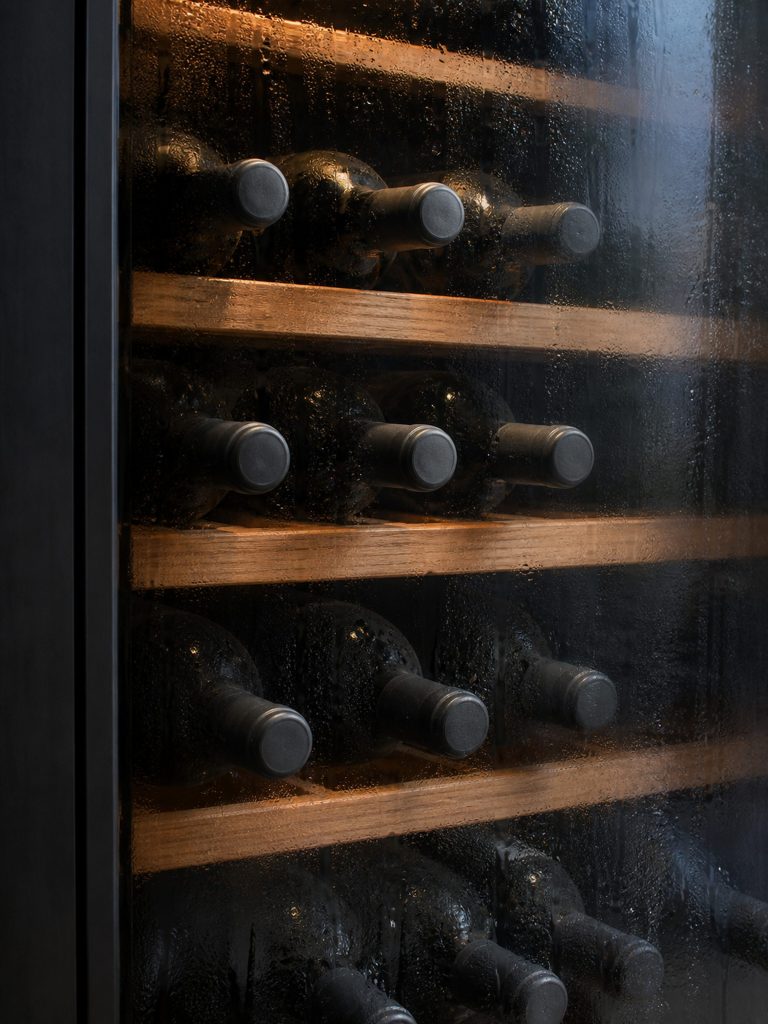
  • Wine bottles lying on wooden shelves behind smoked glass, the inside of the glass fogged with condensation
    One zone, or the whole cabinet

    Wine cooler not cooling

    The first question on a wine cabinet is not what has failed but how much of it. Five of these models hold two zones independently, and a single zone drifting is a much smaller job than the phrase "the wine cooler has failed" suggests.

    • One zone warm, the other right
    • The whole cabinet drifting
    • Bottles warmer than the display claims
    What it usually means
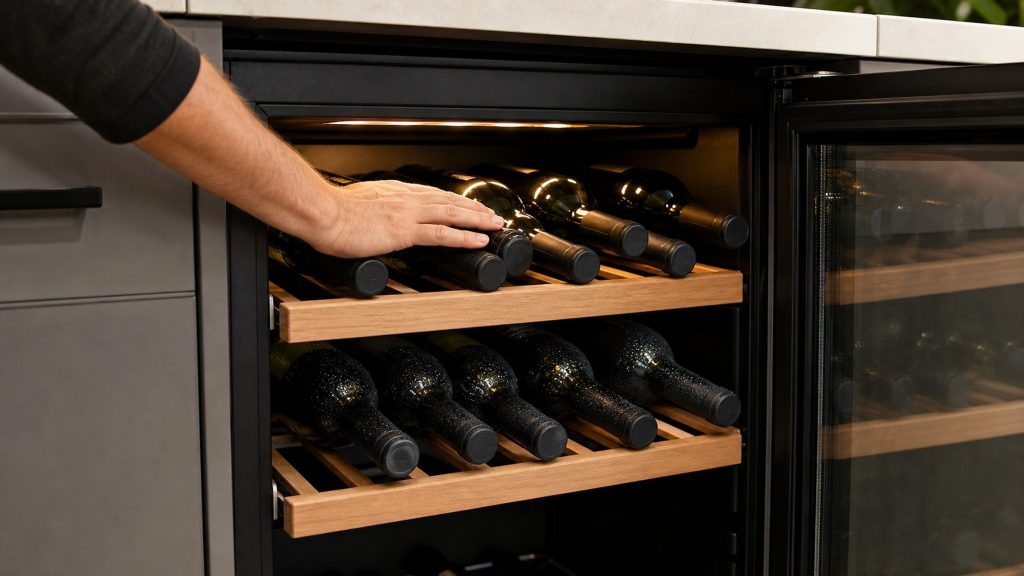
  • An undercounter wine cabinet with its glass door open and two wooden shelves drawn out — the upper bottles dry and warm-lit, the lower ones running with condensation
    A cabinet that shows nothing at all

    Wine cooler will not turn on

    A dark cabinet is not necessarily a dead one. On this make two settings blank the display completely while the appliance carries on working, and both are enabled by holding a button somebody leaned on.

    • Display blank
    • No light, no sound, no display
    • Cabinet still cold inside
    What it usually means
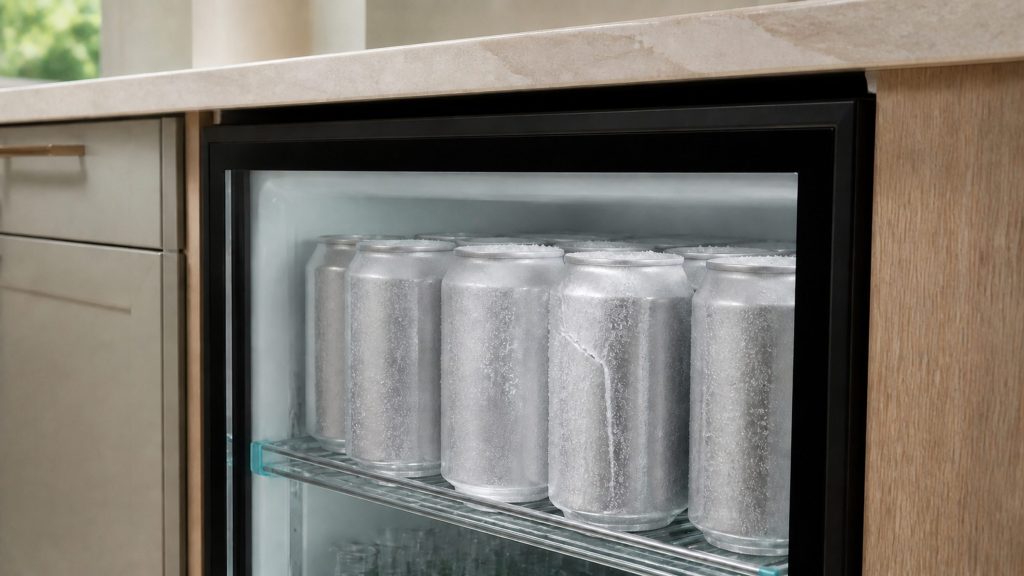
  • Cans standing on the lit shelf of a glass-fronted beverage cabinet with a rime of ice crystals across their tops and a burst seam on one of them, water frozen in a bead down its side.
    Too cold is a failure too

    It is freezing what is inside it

    Frozen cans, a slushy bottle, or ice forming on the back wall of something that should never freeze. On this control that is a short list, and one item on it is not a failure at all.

    • Cans freezing at the back
    • Bottles slushy in the morning
    • Ice forming on the rear wall
    What it usually means
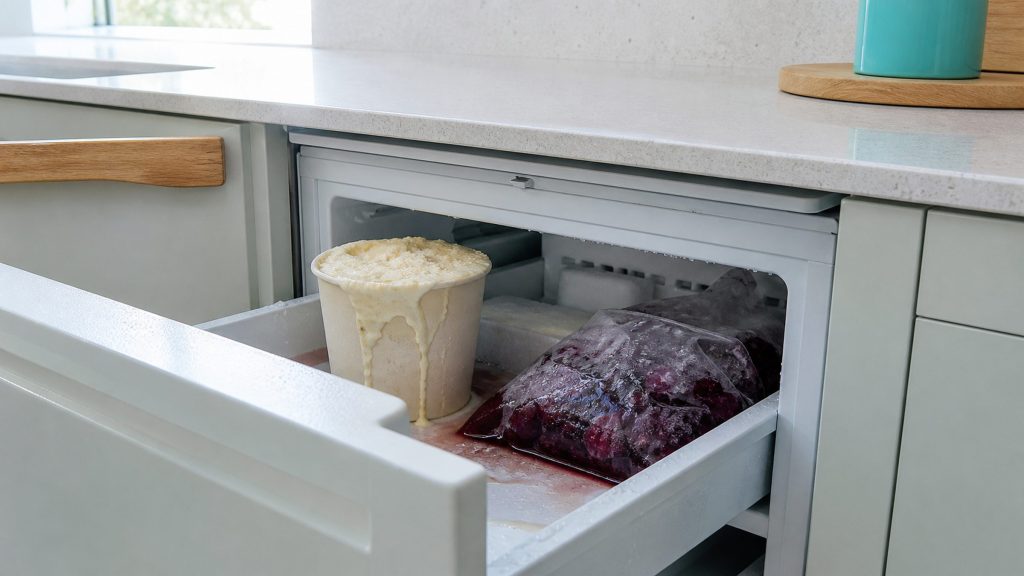
  • An open built-under freezer drawer where the food has plainly thawed — a tub of ice cream slumped soft at the edge, a bag of berries wet and collapsed, condensation beading on the packaging, photographed close in cold light.
    A convertible cabinet has two jobs and one control

    Freezer not working

    U-Line's freezers convert — the same cabinet will run as a refrigerator — which adds a possibility nothing else in this catalog has: a freezer that is not freezing may simply be set to be a refrigerator.

    • Not freezing
    • Set point will not go low enough
    • Frost gone and everything thawed
    What it usually means
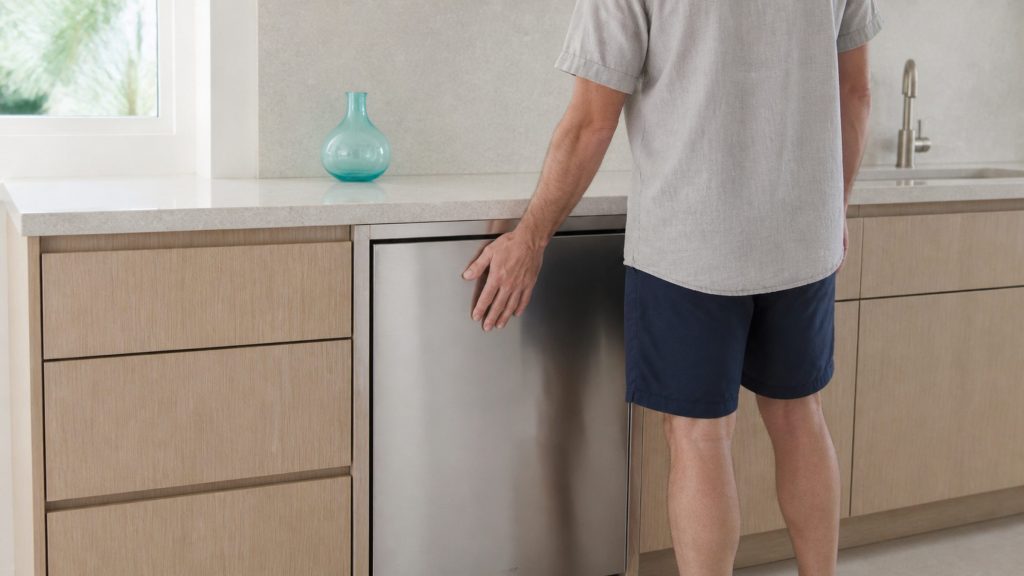
  • A person standing at a pale kitchen counter with one hand resting on the closed stainless door of a built-under cabinet beneath it, head tilted as if listening, face turned away and out of frame, the room otherwise still.
    The one error this appliance says out loud

    It beeps and will not stop

    On a U-Line there is exactly one thing that beeps, and the maker says so in every manual: all errors are logged in memory, and only the door error is displayed and carries an audible signal. So a beeping U-Line is a door until proven otherwise.

    • A tone every minute
    • A door icon on the display
    • Beeping with the door shut
    What it usually means
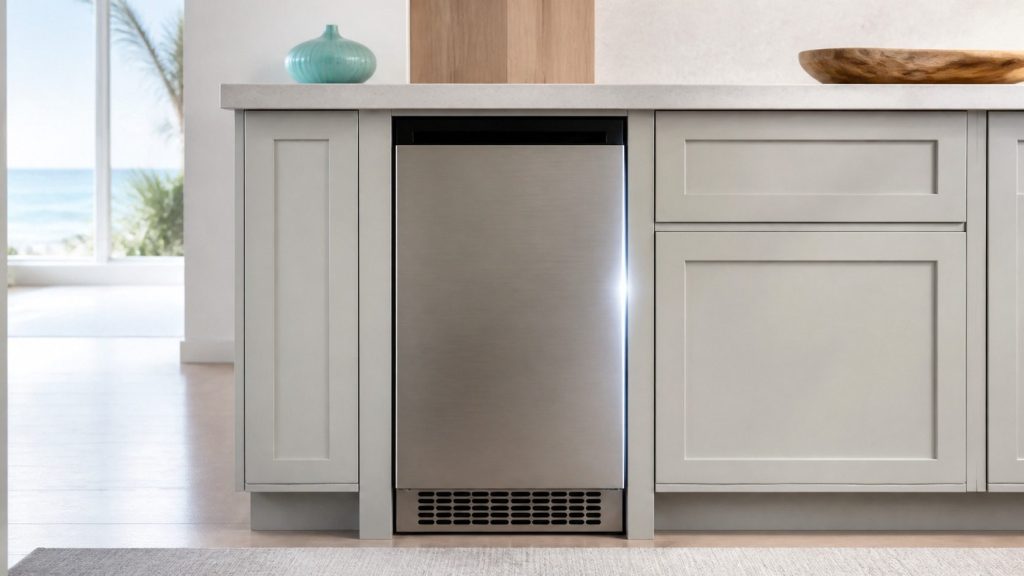
  • A narrow brushed stainless appliance front flush in pale cabinetry beneath a stone worktop, its control strip completely dark and unmarked, photographed straight on in a dim kitchen with one cold reflection along the edge.
    Modes, locks, numbers and letters

    The display is blank, or showing something odd

    More of what appears on a U-Line display is a setting than is a failure, and several of the settings look alarming. A blank panel, a padlock, a bare number, ER, or letters flashing all have documented meanings, and only some of them need anybody to visit.

    • Nothing on the display
    • A padlock icon
    • A number or letters nobody can explain
    What it usually means
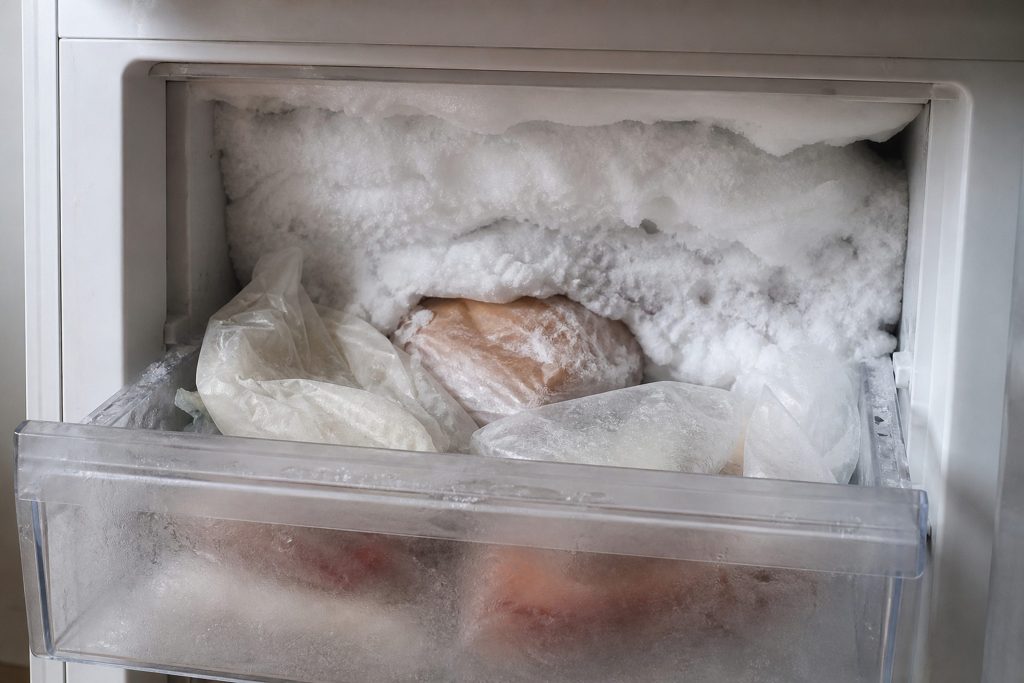
  • The back wall of a freezer compartment carrying a thick white ridge of frost, packages half buried in it, the drawer pulled forward
    Some of it is normal, and the maker gives the threshold

    Frost building up inside

    Frost on the evaporator plate vents is normal on these units and melts during each off cycle — the manual says so. What is not normal is a quarter of an inch or more, and in a humid kitchen the difference between the two arrives faster than the manual assumes.

    • Ice on the back wall
    • Frost that never melts away
    • A quarter inch or more of build-up
    What it usually means
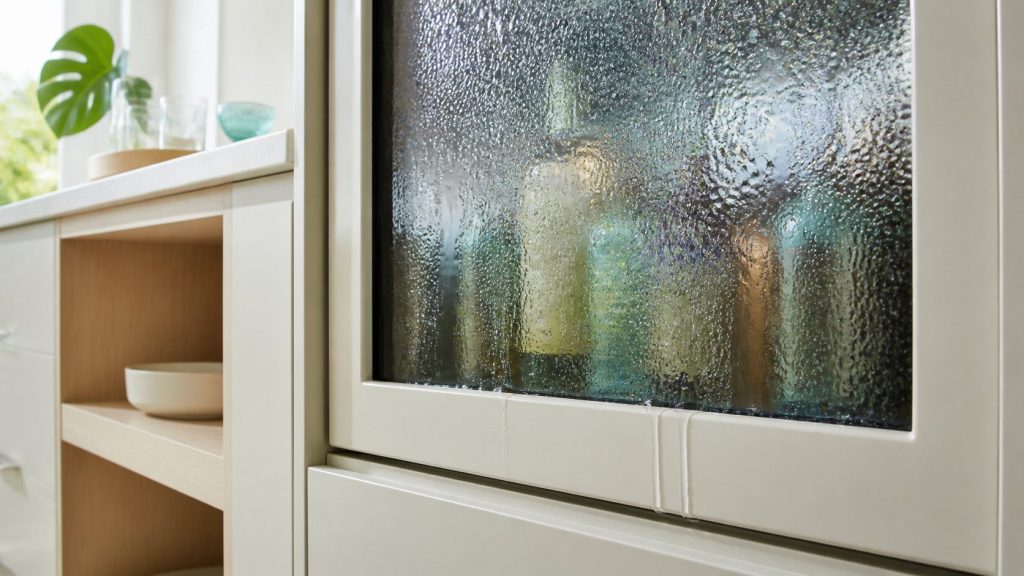
  • Heavy beads of water standing on the outside of a glass appliance door and running in two thin lines down onto the pale cabinet frame below it, the bottles behind the glass soft and out of focus.
    Outside is weather, inside is the appliance

    Condensation on the door or the outside

    Water on the outside of a cabinet in South Florida is often the room rather than the appliance, and the maker says so: the unit is exposed to excessive humidity and the moisture dissipates as humidity falls. Water on the inside of a glass door is a different question.

    • Beads on the outside of the door
    • Misting on the inside of the glass
    • Damp on the cabinetry around it
    What it usually means
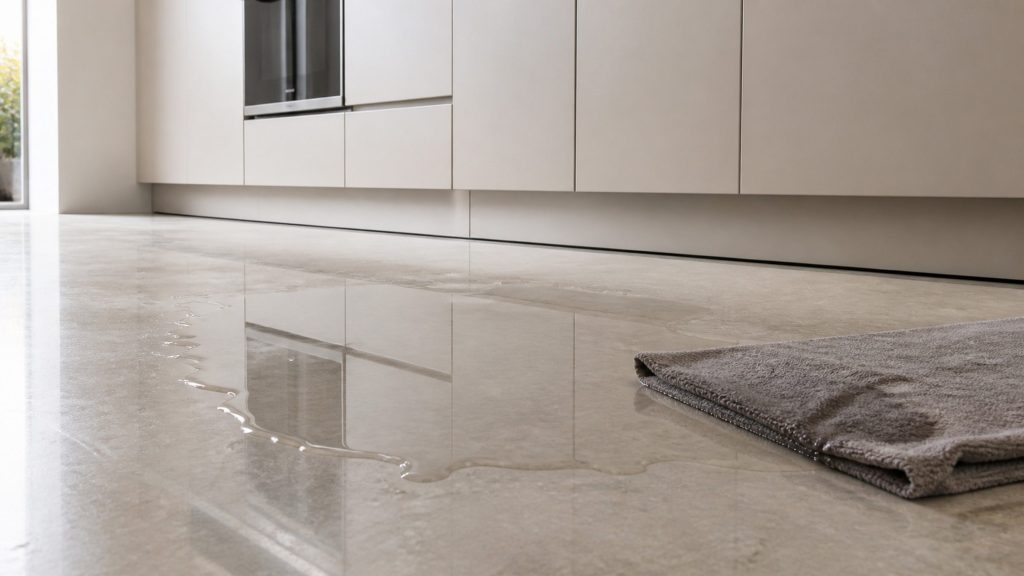
  • Floor-level view along a fitted kitchen: standing water reaching out from under the plinth line, reflecting the cabinet fronts, a gray towel laid at the edge of the spill
    Find it early, because it goes into the joinery

    Water under the unit

    On a built-in appliance a leak damages the cabinetry and the floor before it makes a visible puddle, which is why this one is worth a same-day look. Where it comes from depends on whether the appliance takes water in.

    • A damp patch at the base
    • Water on the floor in front
    • Swollen cabinetry beside the unit
    What it usually means
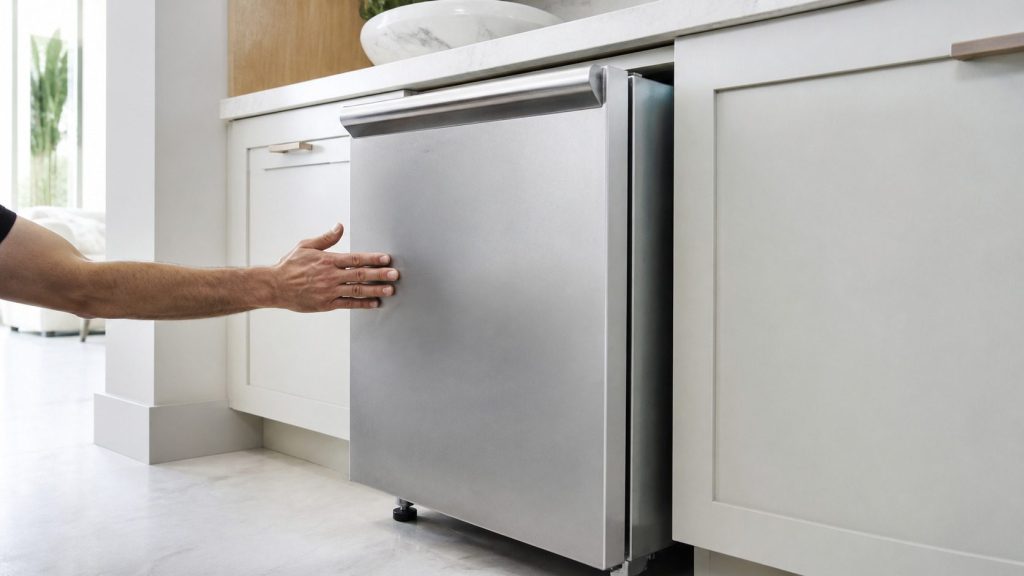
  • A built-under stainless cabinet standing pulled slightly forward from its opening in a pale run, a hand flat against its side panel, the adjustable foot and the dark gap behind it visible at floor level.
    The maker names two causes, and lists what is normal

    Loud or unusual noise

    U-Line publishes a list of what its appliances are supposed to sound like — a compressor hum, refrigerant that sounds like boiling liquid, air through the condenser, water dripping into the drain pan during defrost — and a two-line list of what makes them noisy. Between them, most of these calls are settled.

    • A new noise that was not there before
    • Loudest just after it starts
    • A rattle rather than a hum
    What it usually means
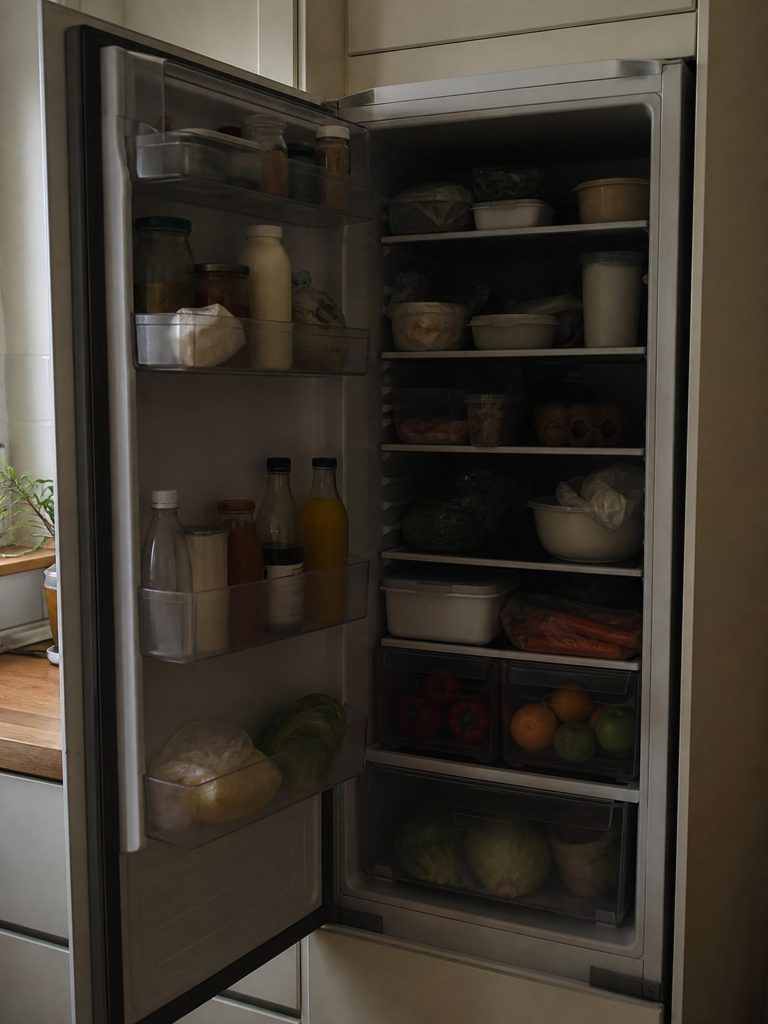
  • An open refrigerator standing dark inside, full of food, lit only by kitchen light spilling in from the left so most of the interior is in shadow
    Two rows in the manual, and one of them is not a repair

    The interior light is not working

    The maker prints two lines about lighting, and between them they cover most of these calls. One of them is a mode. The other is a bracket on the bottom of the door that costs nothing to adjust.

    • No light with the door open
    • The light stays on with the door closed
    • Light works but the display is dark
    What it usually means
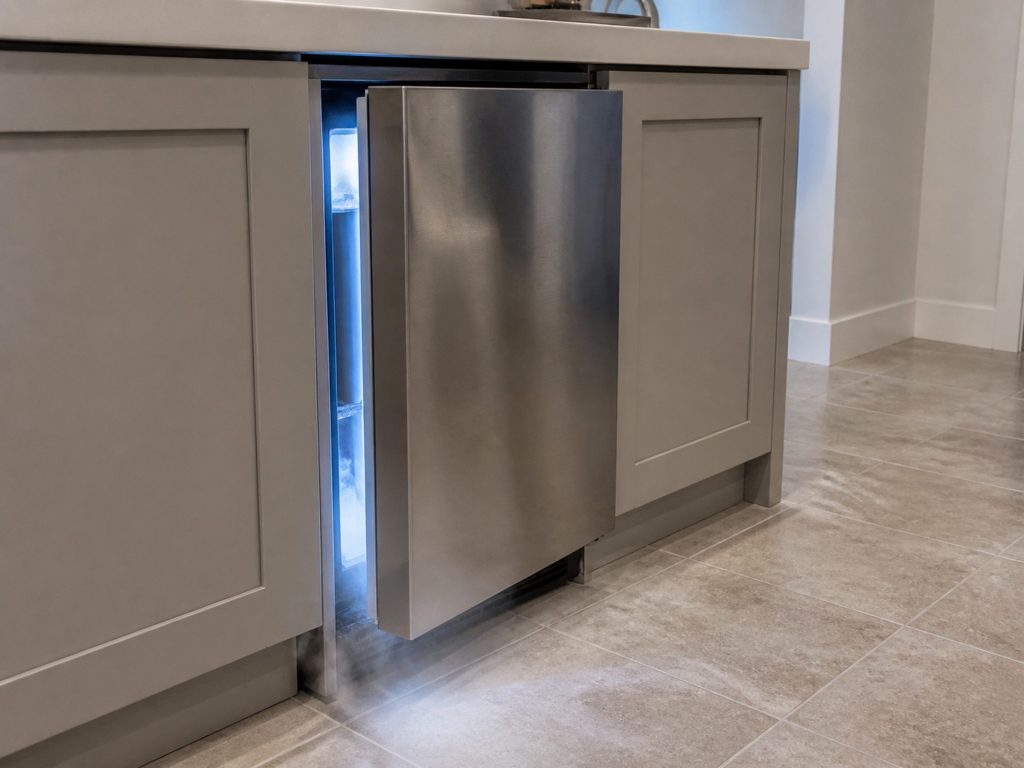
  • An 18-inch stainless undercounter ice maker, door pulled open a hand's width, cold light and vapour spilling from the gap onto the floor tiles
    On a built-in appliance this is joinery as much as appliance

    The door will not close or seal

    A door that rests instead of closing, springs back, or closes without sealing. On a U-Line these are three different problems with three different bills, and the appliance itself is often the last thing that has moved.

    • Springs back rather than closing
    • Closes but the alert keeps sounding
    • Frost or condensation with the door apparently shut
    What it usually means
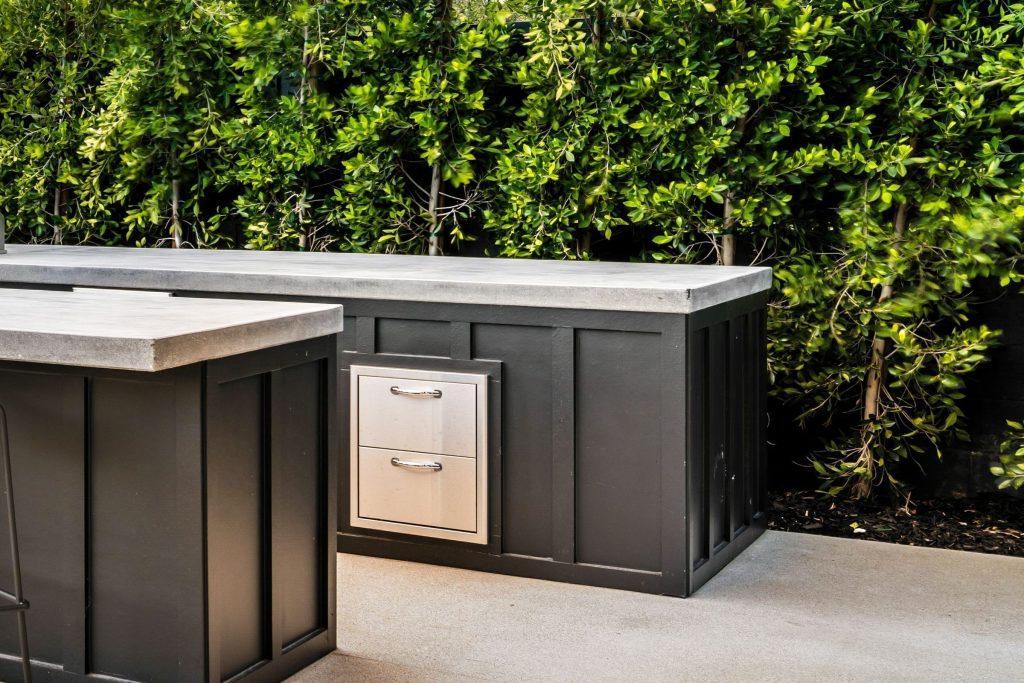
  • A stainless two-drawer unit built into a dark outdoor kitchen island against a hedge
    A quarter of this catalog lives outside

    An outdoor unit struggling in summer

    Twenty-six of these seventy-six models are outdoor units, and in South Florida that is a different job rather than a different location. Salt, humidity and an ambient that sits above what any kitchen sees are the load, and the appliance was designed for it — but only when it is maintained for it.

    • Fine in winter, poor in August
    • Condenser visibly dirty or corroded
    • Running constantly on the hottest days
    What it usually means

The most useful thing to know about this make

Only one error ever reaches your display.

Every U-Line manual that carries a code table prints the same sentence: all errors are logged in memory, and only the door error is displayed and has an audible signal. The numbers are real — fifteen of them — and they live in a service log reached by holding a hidden key for ten seconds.

Which means the ordinary way of using an appliance’s display to work out what is wrong does not work here, and searching for a code you cannot see is not a failure of your search. What you have instead is behavior, and the twenty-two pages on this archive are written to be recognizable rather than technical.

Every number and every signal
The lit interior of a small undercounter cabinet seen through its open door in a dim room, a soft even white glow across empty glass shelves, the pale kitchen around it dark and out of focus.

The two that are not failures at all

A mode that stops the cooling, and a mode that blanks the display.

Showroom mode exists so a dealer can demonstrate a unit without running the refrigeration. The maker’s own description: the degree symbol flashes, the display stays lit, the interior light works, and the unit will not cool. It reads exactly like a dead sealed system and it is two keys held for five seconds.

Sabbath mode does the opposite — display and cabinet lights dark, everything else running, and on the current controls every alarm silenced as well. A cabinet in it looks dead and is working perfectly. Both are enabled by holding a button somebody leaned on, and between them they account for a real share of the calls on this archive.

What each repair costs
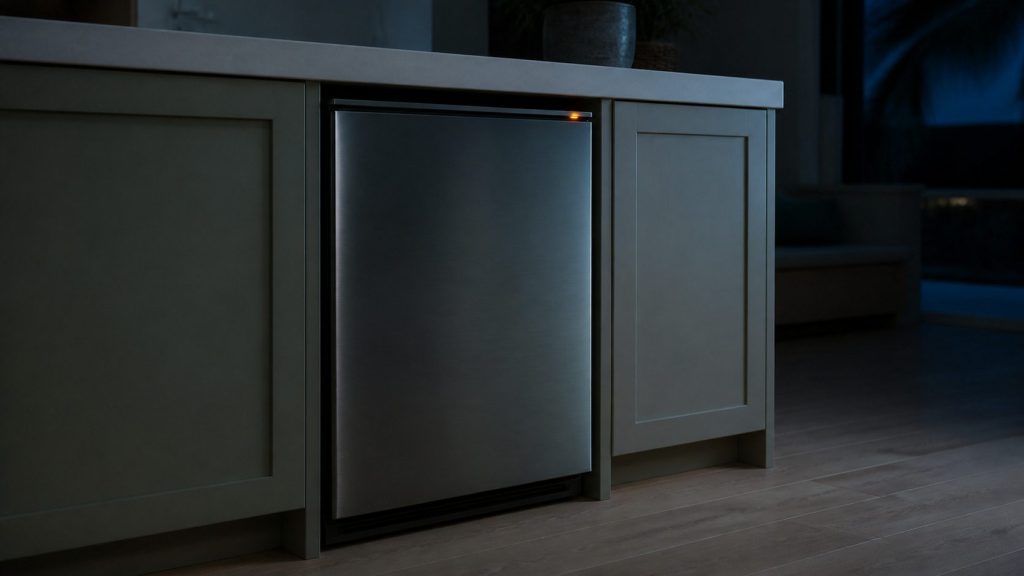
A closed built-under stainless cabinet door beneath a pale worktop in an unlit kitchen at night, a single small amber indicator glowing on its top edge, everything else in near-black.

Before you call

Six minutes that change the visit

Two minutes, and it may be over

  • Degree symbol flashing? Showroom mode — the cooling is off on purpose.
  • Dark display but a cold cabinet? Sabbath mode.
  • Close every door properly and wait a minute — the door alert resets itself.

Measure rather than believe the display

  • A bottle of water and a thermometer, twenty-four hours, door shut.
  • Time one full cycle: ten on and forty off, repeating, is a backup mode.
  • On an ice machine, look at the lamps before anything else.

Write it down before it clears

  • Anything on the display, exactly as shown — photograph it.
  • The model and serial from the plate inside.
  • What changed that week: a move, a power cut, a board, a new kitchen.

By appliance

Or start from the machine you own

An ice machine and a wine cooler describe their problems in completely different languages. If you would rather start from the appliance, these are the seven.

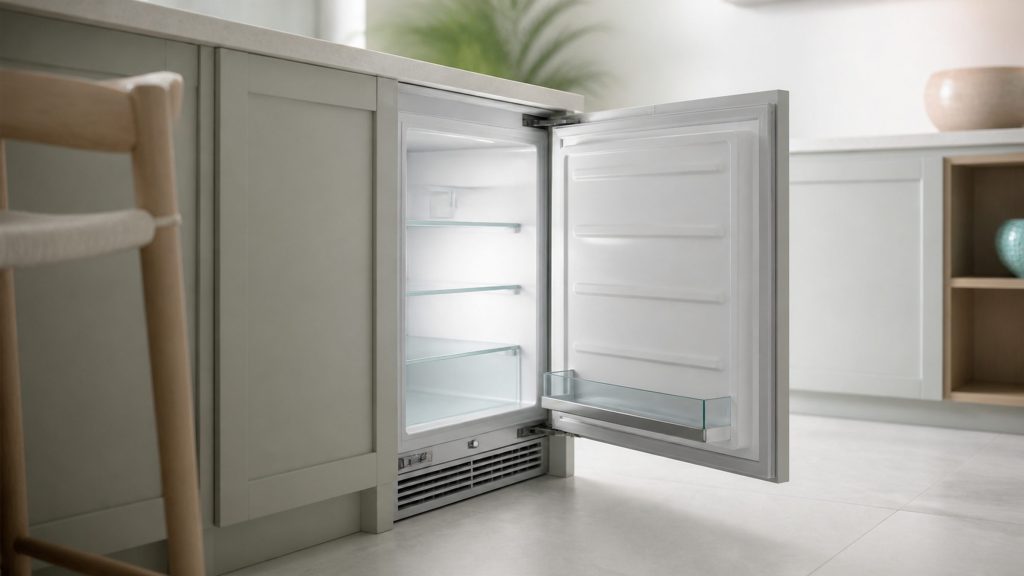
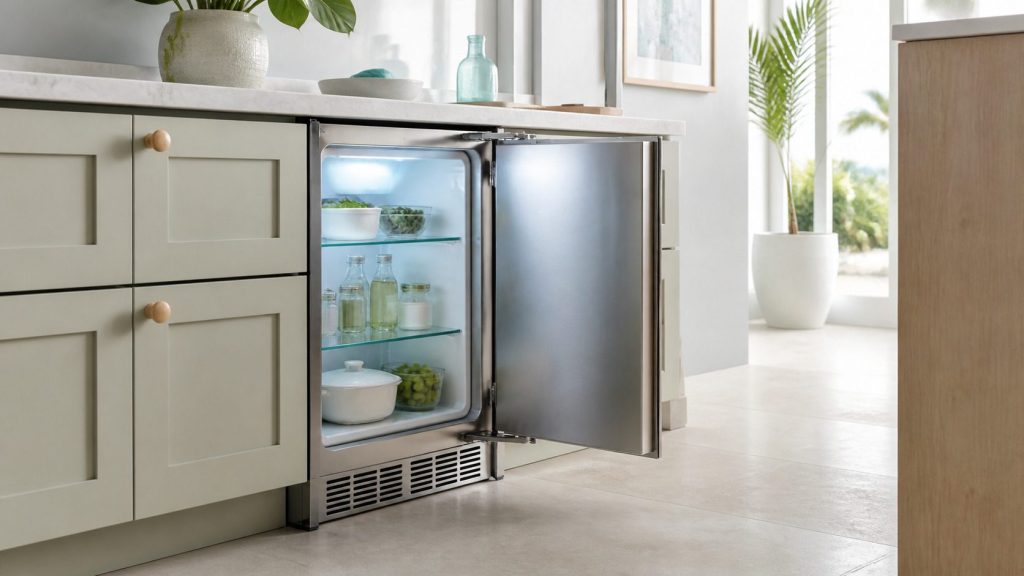
  • A stainless built-under refrigerator 24 inches wide standing open beneath a pale stone worktop, glass shelves inside holding bottles and covered dishes, cool interior light, the ventilation grille along its base visible, pale cabinetry either side.
    25 models · solid, glass and integrated · drawers

    Undercounter refrigerators

    25 refrigerators and refrigerated drawers in U-Line's US catalog, and almost all of them are built into something. Fifteen, eighteen and twenty-four inches wide, in solid, glass and panel-ready fronts, plus the 36-inch modular pair and the drawers. Tell us the model and whether it carries your own cabinet front — that decides how the visit is planned before anything else does.

    • 15, 18, 24 and 36 inches, mostly built in
    • Panel-ready fronts change the visit, not the repair
    • Drawers and combination cabinets included
    Refrigerator repair
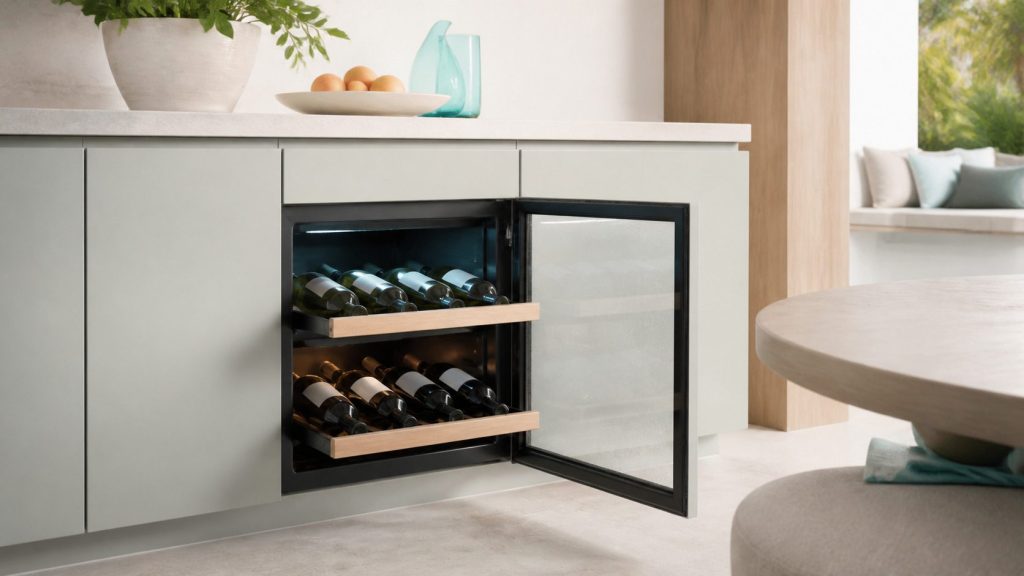
  • A built-under wine cooler with a glass door standing open beneath a pale worktop, two wooden shelf runners drawn out with bottles lying on them, the upper compartment lit slightly cooler than the lower, condensation faint on the inside of the glass.
    17 models · single and dual zone · 15 to 36 inches

    Wine coolers

    17 wine models in the US catalog, five of them holding two zones independently. Wine refrigeration is not food refrigeration set warmer: it holds a temperature you chose rather than the coldest available, it manages humidity instead of driving it out, and it is built to keep vibration away from the bottle. Which cabinet you have, and whether one zone or both are wrong, is most of the diagnosis.

    • One zone drifting while the other holds
    • Warmer than a fridge on purpose — set against wrong
    • Humidity and vibration, which food cabinets ignore
    Wine cooler repair
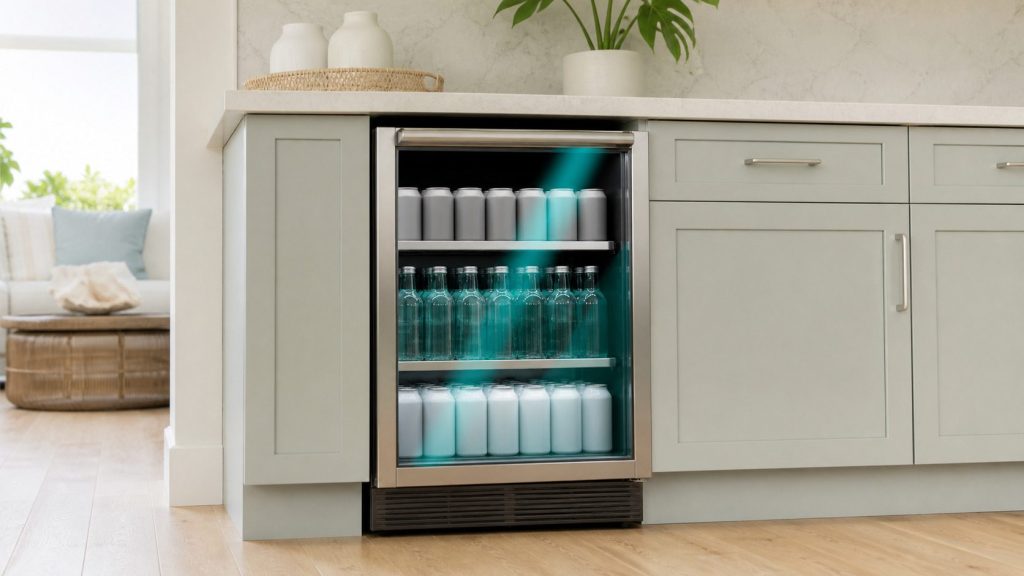
  • A glass-fronted built-under beverage cabinet beneath a pale stone worktop, its door closed, cans and bottles standing in neat rows on three lit shelves behind the glass, a turquoise reflection across the door, pale cabinetry around it.
    16 models · single and dual zone · glass and solid

    Beverage centers

    16 beverage centers in the US catalog, three of them dual-zone. A beverage center is the cabinet between a refrigerator and a wine cooler: colder than wine, warmer than food storage, and shelved for cans and bottles rather than for produce. The dual-zone models are the ones that do both at once, and they are the ones that arrive with half the cabinet wrong.

    • Colder than wine, warmer than a fridge
    • Dual-zone models fail one half at a time
    • Glass doors, and what that does in this climate
    Beverage center repair
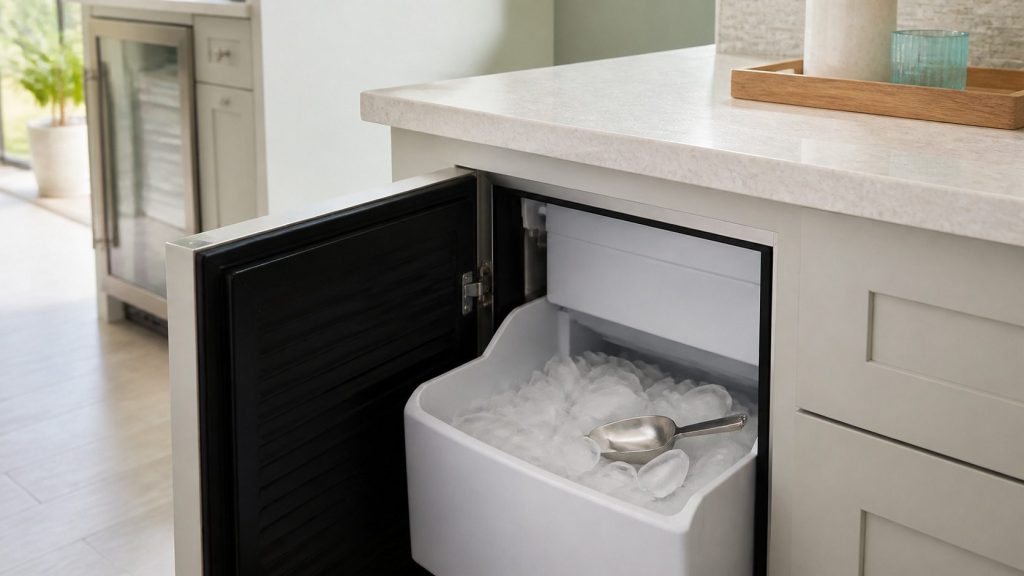
  • A built-under ice maker beneath a pale worktop with its door swung open to show the storage bin part filled with crescent-shaped ice, the curved cubes clearly not square, a metal scoop resting on top of them.
    10 models · crescent ice · U-Line's oldest line

    Ice makers

    10 crescent ice makers and combination refrigerator/ice makers. U-Line has been building these since 1962 and they are the simplest cold appliance in the range: a fill valve, a mold, a heater to release the ice, and a mechanical arm that stops the machine when the bin is full. When one stops, the cause is nearly always water arriving, water leaving, or the harvest sticking.

    • Crescent cubes, mechanical harvest, bin arm
    • Water problems outnumber everything else
    • No service menu on most of them
    Ice maker repair
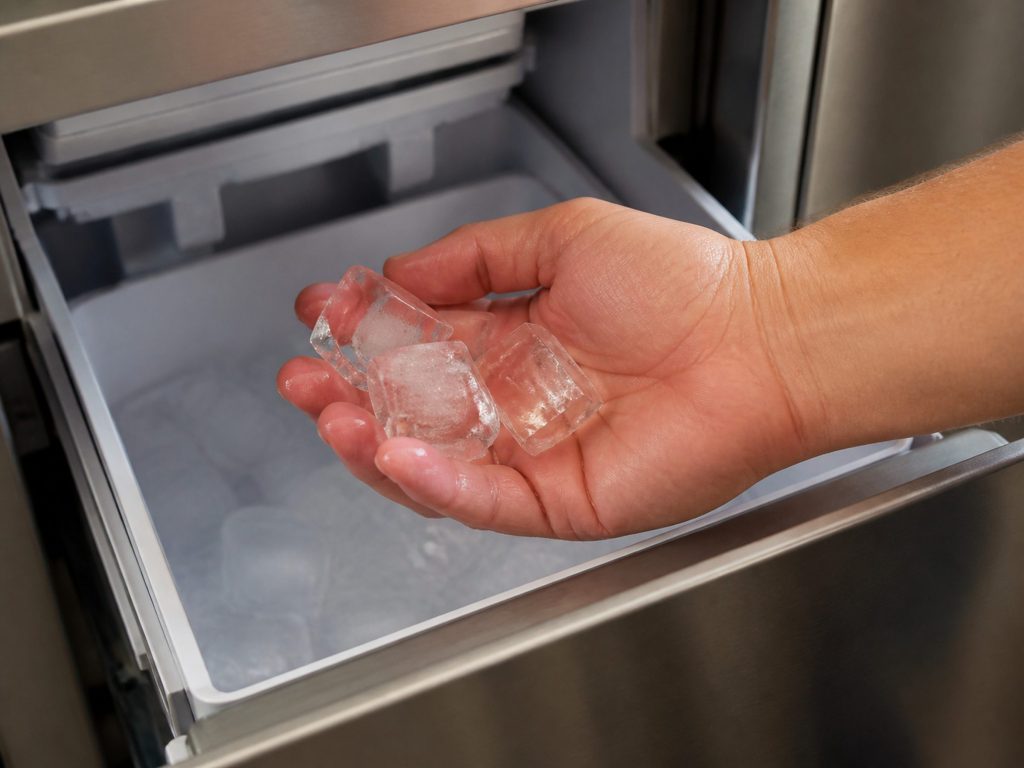
  • A cupped hand lifting a few large clear ice cubes out of the bin of a 15-inch undercounter ice maker, the rest of the bin below in soft focus
    6 models · clear ice, craft ice and nugget

    Ice machines

    6 ice machines — clear ice, craft clear ice and nugget — and they are a different appliance from a crescent ice maker. Clear ice is made by freezing moving water slowly; nugget ice is made by driving a screw through ice on the wall of a cylinder. Both have a water circuit, a harvest and, on most installations, a drain. Anything that interrupts the water changes the ice before it stops the machine.

    • Clear, craft and nugget — three different machines
    • The ice itself is evidence before anything fails
    • Scale is what ends them in this climate
    Ice machine repair
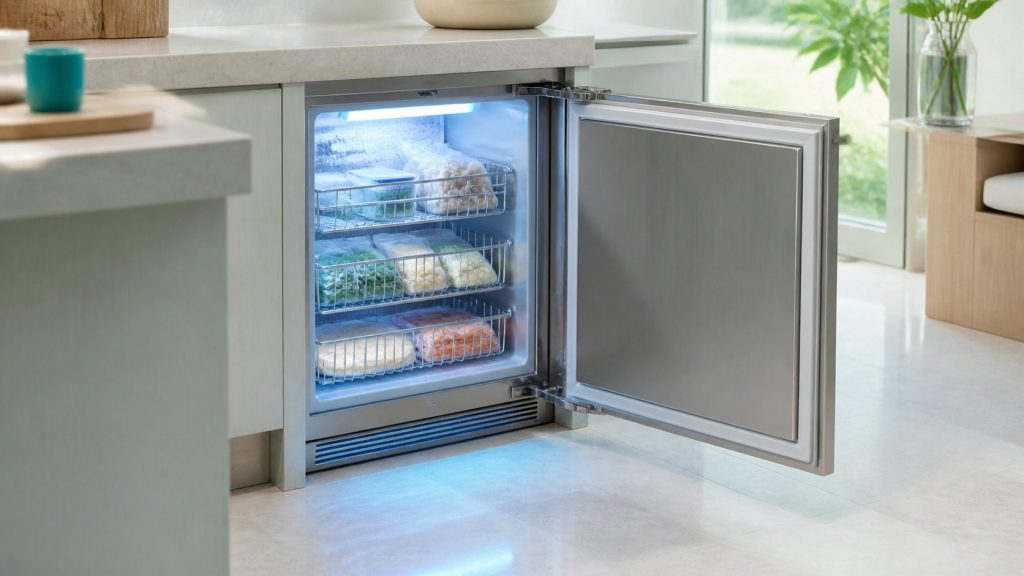
  • A built-under stainless cabinet beneath a pale worktop with its door open on wire baskets of frozen food, a thin bloom of frost on the rear wall, cold blue interior light spilling onto the pale floor.
    2 models · convertible · indoor and outdoor

    Convertible freezers

    2 convertible freezers — cabinets that will run as a freezer or as a refrigerator, indoors or outdoors, depending on what you ask them for. That flexibility adds a possibility nothing else in this catalog has, and it is the first thing to check when a freezer is not freezing: it may simply have been asked to be a refrigerator.

    • Converts between freezer and refrigerator
    • Less margin than a refrigerator when a sensor fails
    • Frost has a published threshold on this make
    Freezer repair
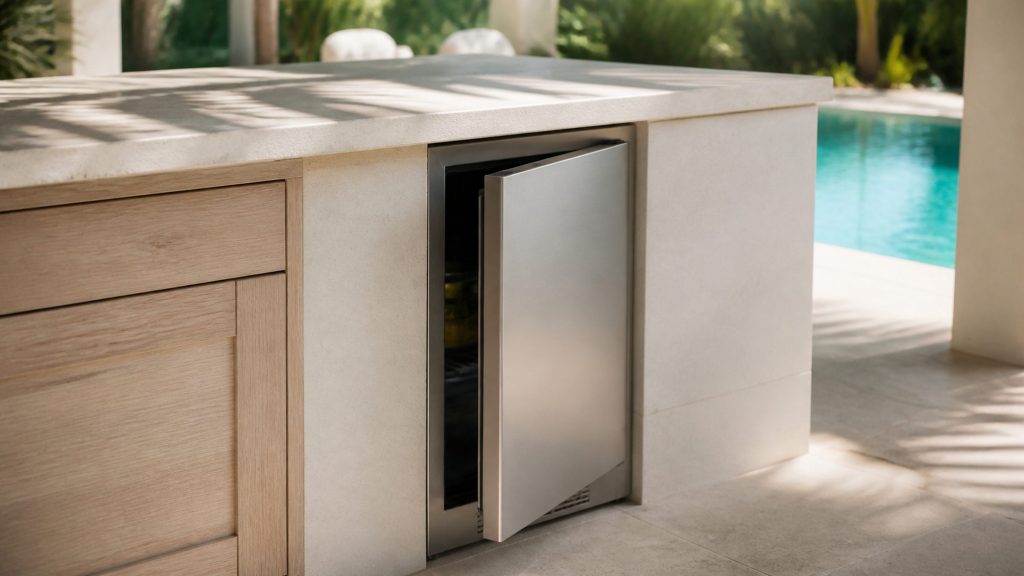
  • A stainless built-under refrigerated cabinet set into pale rendered masonry on a shaded poolside terrace, its door slightly open, bright Florida daylight, palm shadow across the stone top, turquoise pool water out of focus behind.
    26 models · terraces, summer kitchens and boats

    Outdoor refrigeration

    26 of the 76 models in U-Line's US catalog are outdoor units, and several more are marine. That is a quarter of the range living in salt air, sun and August humidity — conditions the appliances are built for, and built for with maintenance. Out here the interval between services is shorter than any manual assumes, and salt does to a repair what nothing in a kitchen does.

    • A quarter of the catalog lives outside
    • Salt corrodes the fixings before it stops the cooling
    • Marine models, and the boats they are on
    Outdoor unit repair

If yours is not here

These are the ones people describe most, not all of them.

Twenty-two behaviors, chosen because they are what people actually type. Cold equipment does other things, and an undercounter cabinet in a Miami kitchen does a few that nothing else does. Describe it in your own words when you book — including the things that sound too small to mention, which on this make are frequently the diagnosis.

Before you book

The questions this page is asked

It is beeping. Is that an emergency?

Almost never. On this make the door is the only error that makes a sound — the maker says so in every manual. Close every door properly and wait a minute; the tone stops and the alert resets. What is worth a call is beeping that continues with the doors shut, which means a switch is reporting something that is not happening.

The display works but nothing is cold.

Look at the degree symbol before you call anybody. Flashing rather than steady is showroom mode, and the refrigeration is switched off on purpose. Light key and power key together for five seconds. Floor models get sold and units arrive in this mode more often than anyone expects.

There is a number flashing on my ice machine.

Eleven, twelve and thirteen are real and the maker prints them — water level high, water level low, and an auger error. They are shown as bare digits rather than as codes, which is why searching for them finds so little. One honest caveat: they sit on the control board's list and no model's own service menu among the manuals we read claims them.

It runs constantly and still is not cold enough.

That is the most common call on this make and it is usually a temperature sensor. U-Line's backup mode keeps a unit cooling on a fixed cycle after a thermistor fails, showing nothing at all — so the appliance knows what is wrong and cannot say so. Reading the error log turns a sealed-system quote into a sensor.

Some of this sounds like it might be normal.

A good deal of it is, and we would rather say so on the page than at the end of a paid visit. External condensation on a humid day, frost on the evaporator vents below a quarter of an inch, and refrigerant that sounds like boiling liquid are all documented as normal by the maker.

In more detail

Why a description is worth more than a code on this make

On most brands the fastest diagnosis is the number on the display: it narrows a repair to two or three possibilities before anybody drives anywhere. U-Line does not work that way. Its control logs fifteen numbers and shows exactly one of them — the door — so what an owner can contribute is not a code but an accurate account of behavior.

That turns out to be a good trade, because behavior on this equipment is unusually diagnostic. A fixed ten-on, forty-off cycle is a failed zone sensor. A flashing degree symbol on a warm cabinet is a demonstration mode. Three lamps flickering twice in turn is a nugget machine asking for its cleaning cycle. Ice that came out wet, then slushy, then stopped is an auger. Each of those is more specific than most error codes manage.

South Florida adds its own patterns. Every door opening loads a small cabinet with humid air, so frost and condensation complaints run ahead of the national average and are more often about the door than about the defrost circuit. Outdoor units — a quarter of this catalog — degrade gradually through a year of salt and then miss a summer. And ice machines here scale on a schedule the maker’s own six-month cleaning signal was not written for.

Which is why every page on this archive begins with what you can check rather than with what it might be. Several of them end there, and that is the intended outcome rather than a disappointing one.
Describe it in your own words.

What it is doing, when it started, and anything on the display. That plus the model number is enough to bring the right parts.

This article is based on:

  • Official manufacturer documentation
  • Internal repair procedures
  • Technician repair history
  • Company quality standards
Call (305) 851-2207