Troubleshooting
How to Test a Refrigerator Thermistor — With the Maker’s Own Number
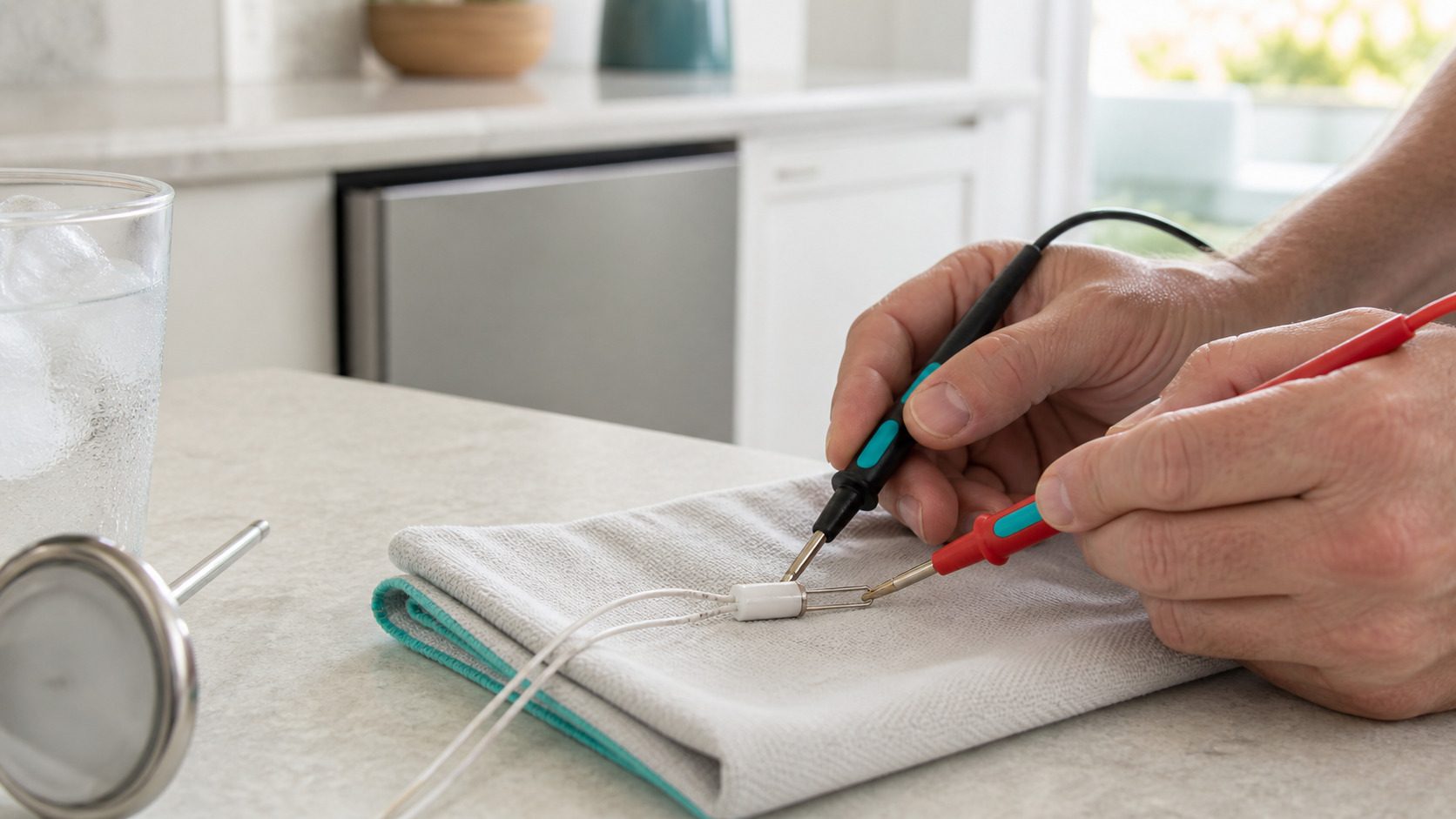
Isolate the appliance at the breaker, unplug the sensor from its harness, and put its tip in a bath of ice and water — actual ice, actual water, stirred, given a couple of minutes to settle at freezing point. Read across the two pins with a multimeter on resistance. U-Line publishes the number this should give: about 16.1k ohms, within five percent. A reading far outside that, or an open circuit, or a dead short, is a failed thermistor. A reading inside it means the sensor is fine and the problem is elsewhere — most often the connection, which is why U-Line puts dielectric grease on every thermistor connection at the factory and says outright that a corroded connection changes the resistance value on its way to the board. This matters more on a U-Line than on most appliances: when a zone thermistor fails, the control does not stop and does not complain. It switches to a backup mode, keeps cooling on a fixed cycle to protect the contents, and shows nothing at all.
The full guide
How to test refrigerator thermistor with multimeter: why this test is the first one on a U-Line
Most makes tell you when a sensor has failed. This one does not — and what it does instead is the single most useful thing to know about the appliance.
From U-Line's own service manual: if a zone thermistor fails, the unit continues to cool in a backup mode — Self Preservation Mode — to preserve the integrity of the contents, and otherwise operates normally. On the 2000 Series that backup is a fixed cycle, ten minutes on and forty minutes off, whatever the cabinet actually needs.
So the appliance does not stop. It does not beep. It does not put anything on the display. It runs, it lights up, it answers every button, and it never quite gets where you set it. The complaint that arrives is *"it runs all the time and it still isn't cold enough"*, and on a bad day that gets quoted as a sealed system.
A thermistor is an inexpensive part. A sealed system is not. That is the whole reason this page exists.
The number, and why it is worth having
A thermistor is a resistor whose value changes with temperature, so "is it good" is meaningless without "at what temperature". Fix the temperature and the question becomes answerable.
U-Line publishes the figure: about 16.1k ohms in an ice-water bath, plus or minus five percent. Its own manual gives it in the same paragraph as the warning about connections. Very few makers print this, and it is the difference between a measurement and an opinion.
Doing it properly
Isolate first. At the breaker if the unit is built in, because you are not going to reach the plug. Everything below assumes the appliance is dead.
Make a real ice bath. Ice and water in a cup, stirred, left a couple of minutes. A cup of ice with no water in it is not at freezing point and neither is cold tap water; both will give you a number that means nothing.
Unplug the sensor from the harness and read across its two pins. Multimeter on resistance, autoranging or set to the 20k–200k region. Give the tip time in the bath before you read — thirty seconds is not enough, two minutes is.
Compare. Within five percent of 16.1k: the sensor works. Open circuit: the sensor or its lead has broken — that is what the control logs as E1, E2 or E3. Dead short or a wildly low reading: E5, E6 or E7. Far off but not open or shorted: it has drifted, which is the one the appliance hides best.
The half that gets skipped
A sensor that tests good and a cabinet that is still wrong is not a dead end. It is a pointer at the connection.
U-Line applies dielectric grease to every thermistor connection during manufacture, and its manual says why: a connection that has corroded changes the resistance values on their way through to the board. In practice that means a perfectly good sensor can be reporting a temperature that is several degrees out because of a dull green contact behind a panel.
So the connector gets looked at, cleaned, and re-greased rather than reconnected as found. A repair that puts a new sensor into a corroded connector fails the same way in a season.
Which sensor, and how to know before you start
The error log names them, and reading it first saves testing three to find one:
| Logged | What it is |
|---|---|
| E1 / E5 | Thermistor 1 — the cabinet sensor, reading the compartment |
| E2 / E6 | Thermistor 2 — the evaporator sensor, which defrost timing is set by |
| E3 / E7 | Thermistor 3 — multi-zone and combination cabinets only |
The odd fact worth knowing: on a single-zone cabinet, U-Line's own service menu writes *"does not apply to this model"* against E3 and E7. The same number means a real problem on one U-Line and nothing at all on another.
When to stop and call somebody
- If the reading is fine and the cabinet still is not. The next steps are in the service menu — sensor offsets, defrost parameters, the model number the board is programmed to — and that is a different kind of work.
- If you cannot reach the sensor. The evaporator sensor lives behind a panel inside the cabinet, and on an undercounter unit that is a genuinely awkward space.
- If more than one sensor tests badly. That is rarely three failed sensors. It is usually one thing upstream of all of them.
Whatever you find, write the readings down. A technician arriving to *"I measured 16.4k in ice water and the cabinet still sits four degrees warm"* starts a long way ahead of one arriving to *"it isn't cold"*.
If it turns out to be a repair
What this leads to, and what it costs
Every job on this site is priced the same way: an on-site diagnostic first, the figure agreed in writing before anybody starts.
-
Thermistor and temperature sensor replacement
The most likely single failure on a U-Line, and the one the appliance is designed not to mention. When a zone sensor fails the unit does not stop — the maker's own backup keeps it cooling on a fixed cycle to protect what is inside, and it otherwise behaves normally. So the complaint that arrives is never "the sensor has failed". It is "it runs all the time and still is not cold enough".
- The failure behind most "not cold enough" calls
- Measured against the maker's own figure, not swapped on sight
- Connections cleaned and re-greased, which is half the repair
-
U-Line error code E5
U-Line error code E5: Thermistor 1 shorted. In plain terms, the cabinet sensor — the one reading the compartment you keep things in, and the control has lost it. Which machines can actually raise it, where the number lives on this make, and what to do next.
What this one means -
U-Line: It runs, it shows nothing, and it never gets cold enough
U-Line — an indicator rather than a code. This is the most important thing on this page and the appliance will not tell you about it.
What the machine is telling you -
Not cold enough
A cabinet that is cold, but not at its set point, and never has been since something changed. On this make that pattern has a specific and documented cause that shows nothing on the display, which is why it gets lived with for months.
- A few degrees out, all the time
- Worse when the kitchen is warm
- Runs longer than it used to
Questions people ask about this
What should a refrigerator thermistor read?
It depends on the temperature it is at, which is why the test is done in ice water — that fixes the temperature at a known point. U-Line's own figure for its sensors in an ice-water bath is about 16.1k ohms, plus or minus five percent. A sensor read at room temperature will read much lower and tells you almost nothing.
Can I test it without removing it?
You can read it in place if you can reach the connector, but you cannot control its temperature, so all you learn is whether it is open or shorted. That is worth knowing — an open circuit and a dead short are both failures — but a sensor that is merely drifting will look fine.
The sensor tests good and the cabinet is still wrong. Now what?
Check the connector before anything else. U-Line applies dielectric grease to these connections in the factory precisely because a corroded one changes the value the board sees. After that it is the board's reading of the sensor rather than the sensor itself, and that is a service-menu job rather than a multimeter one.
How do I know which thermistor to test?
The error log names it: E1 and E5 are the cabinet sensor, E2 and E6 are the evaporator sensor, E3 and E7 are the third sensor that only multi-zone and combination cabinets carry. Reading the log first saves testing three sensors to find one.
Is a thermistor an expensive part?
No, and that is rather the point of this page. It is the access, the diagnosis and the connection work that make up the figure — not the component. On an appliance where a failed sensor gets quoted as a sealed system, the difference is several hundred dollars.
Troubleshooting
More guides like this one
-
Your U-Line Is Keeping an Error Log You Cannot See
Every U-Line manual says the same sentence: all errors are logged in memory, and only the door error is displayed. The numbers are real. You just are not being shown them.
Read more -
The Light Works, the Display Works, and Nothing Is Cold
On most refrigerators this points at the compressor. On a U-Line, check the degree symbol first — there is a setting that runs the display and the light and switches the cooling off entirely.
Read more -
How to Reset a U-Line — and Why There Is No Reset Button
There is no reset button on a U-Line. What exists is a power cycle, two modes people mistake for a failure, and a service menu — and one of those choices destroys the only evidence the appliance kept.
Read more
Tell us the model number and what it is doing.
This article is based on:
- Official manufacturer documentation
- Internal repair procedures
- Technician repair history
- Company quality standards