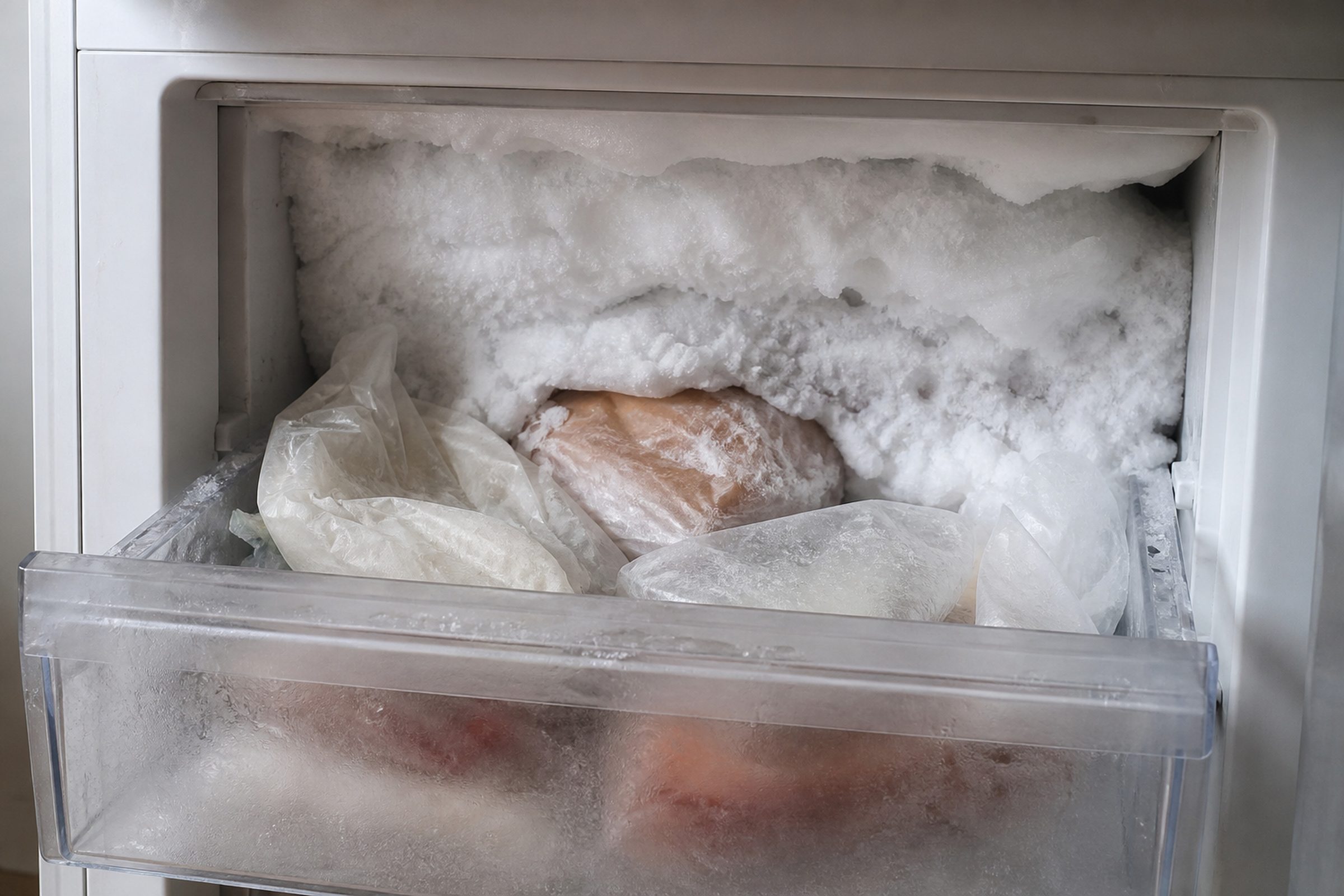
- “Ice on the back wall”
- “Frost that never melts away”
- “A quarter inch or more of build-up”
Symptom
U-Line frost building up inside
Frost on the evaporator plate vents is normal on these units and melts during each off cycle — the manual says so. What is not normal is a quarter of an inch or more, and in a humid kitchen the difference between the two arrives faster than the manual assumes.
- From $95 diagnostic, credited to the repair
- 59 cities and neighborhoods covered
- OEM parts available on order
- In writing the price, before anything is opened
Four ordinary causes
What this usually turns out to be
Cheapest and commonest first, which is also the order we check them in. They sit hundreds of dollars apart, and only the unit settles which one is yours.
-
A door not sealing, or opened too often
The manual's own first answer, and in this climate every opening loads the cabinet with humid air.
Door seal replacement from $155 -
A door held slightly open
By a bin, a bottle rack or a run of cabinetry that has moved. The alert may not even trigger for a gap this small.
Door alignment and hinge repair from $175 -
The defrost circuit or its settings
Heater, sensor, or an interval and duration set for a different machine.
Cooling and defrost repair from $185 -
Ambient humidity
The manual names high ambient temperature and excessive humidity outright. On a terrace in August that is not an excuse, it is the load.
Outdoor and marine unit service from $195
In five minutes
Before you call anybody
None of it needs tools, and all of it makes the visit shorter.
-
01
Measure the build-up
The maker's threshold is a quarter of an inch. Below that, frost on the evaporator plate vents is normal and clears on the off cycle.
-
02
Paper-test the door
A slip of paper closed in the door, at several points. Where it pulls out freely is where the humid air is getting in.
-
03
Count how often the door opens
In this climate every opening is a load of moisture. A cabinet in a busy kitchen frosts faster than the manual assumes.
-
04
Look at where the frost is
On the rear wall is one story; around the door and the front of the cabinet is a different one and it is nearly always the seal.
How it shows up
What people describe when they call
A shortcut
Narrow it down before anybody arrives
A description of the behaviour leaves a few possible causes. A code names the subsystem before anybody opens anything, which is why it is worth photographing before it clears.
If the display is showing something
Photograph it before it clears — codes do not wait. Search the full code list
In more detail
About U-Line frost building up inside
Measure the build-up before deciding anything
The maker's own threshold is a quarter of an inch. Below that, frost on the evaporator plate vents is expected and clears on the off cycle. Above it, something is putting more moisture in than the defrost can take out, and the door is where that story usually starts.
Some frost is the appliance working
The manual is specific: frost on the evaporator plate vents is normal and melts during each off cycle. What is not normal is a quarter of an inch or more. Having a published threshold is unusually helpful, because it turns an argument about whether there is 'a lot' of ice into a measurement anybody can take.
In South Florida the door is nearly always the answer
Every time a cabinet opens here it takes in air carrying a great deal of water, and all of that water ends up on the coldest surface inside. A seal that has taken a set, a door held a millimeter open by a bin, or simply a busy household will put more moisture in than the defrost cycle was designed to take out.
This article is based on:
- Official manufacturer documentation
- Internal repair procedures
- Technician repair history
- Company quality standards
Before you book
Questions about U-Line frost building up inside
I defrosted it and it came back.
Then the ice was the symptom. Manual defrosting is worth doing to get the appliance working again, but whatever is putting the moisture in is still doing it.
Only the freezer side frosts.
That is normal to a degree — a colder compartment collects more. It becomes a problem at the same quarter-inch threshold, and on a convertible cabinet it is worth confirming which mode it is running in.
Where we do it
Across Miami-Dade, Broward, and Palm Beach
Same terms everywhere we go: an on-site diagnostic first, the price agreed in writing, and the exact figure confirmed once we have seen the unit.
Neighborhoods people ask for by name