Safety & Risks
A Burning or Electrical Smell From a Refrigerator
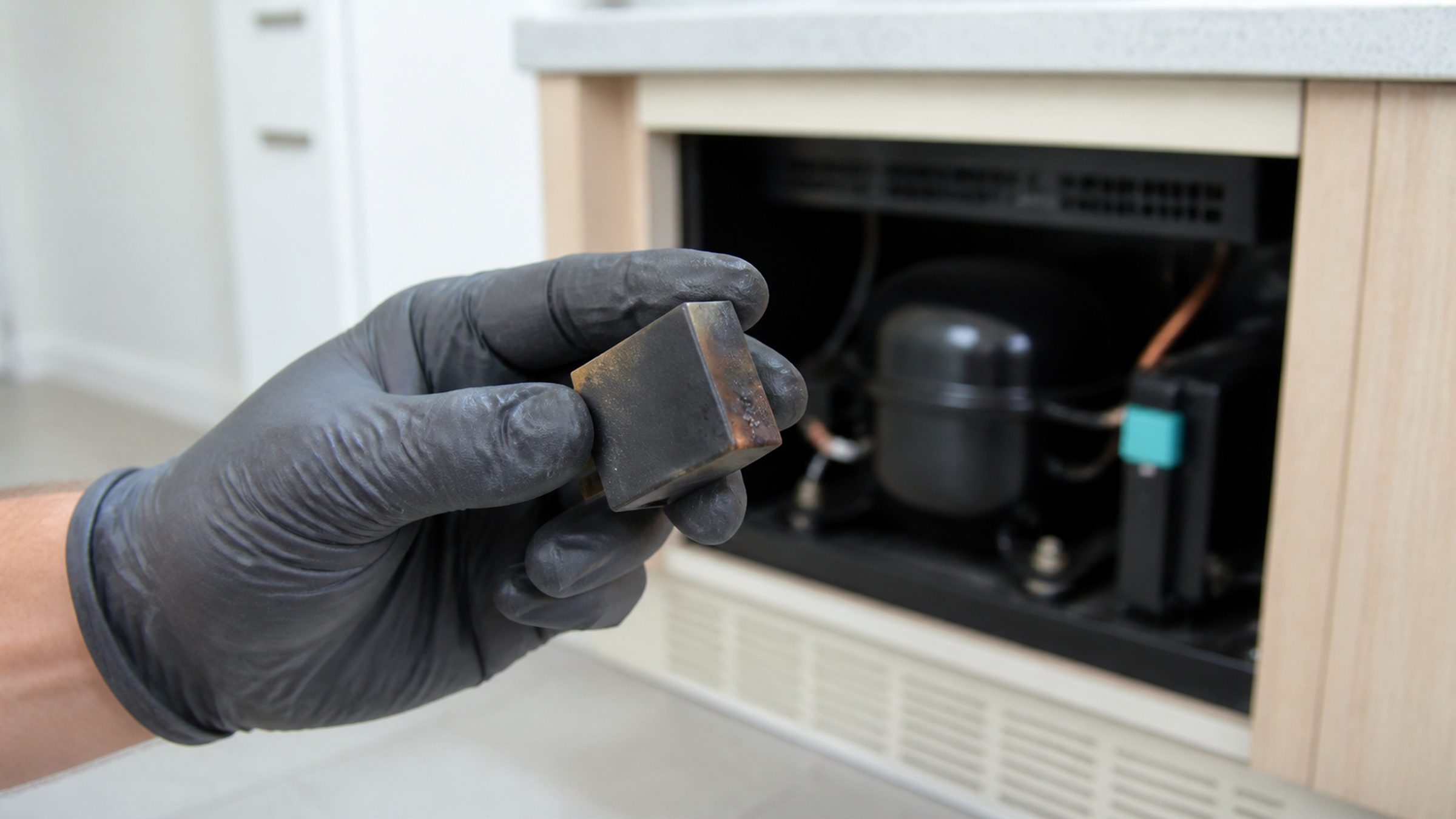
Switch it off at the breaker or the plug, not at the appliance's own power button — a unit switched off at its control is still live at the terminal block. Then decide which smell you have, because two very different things arrive described the same way. Dust on a warm condenser smells dry and dusty, like a heater at the start of winter; it appears when a unit has been working hard, and it goes away after the coil is cleaned. Insulation smells sharp, acrid, chemical, faintly like burnt plastic, and it does not fade with running. The second is the one that means the appliance stays off until somebody has looked at it. What gets checked afterwards is electrical rather than refrigeration: the supply cord and the outlet behind the unit, the terminal block, the start components or inverter driver beside the compressor, and the connectors on the control board — which is the order U-Line's own power-failure flow chart works through.
The full guide
Refrigerator burning smell dangerous: the first five minutes
Switch it off at the breaker or unplug it. Not at the appliance's own power button — a U-Line switched off at its control still has mains at the terminal block, and if something in there is overheating, that is not where you want it.
On a built-in unit the breaker is the practical answer, because the outlet is behind the appliance and you are not going to reach it without pulling the unit out of the joinery.
Then stop and smell it properly, once, before anybody moves anything. What you are trying to decide is which of two smells this is, and they mean very different things.
Two smells, one description
Dust on a warm condenser. Dry, dusty, faintly like a radiator or a heater switched on for the first time in autumn. It appears on a unit that has been running hard — a hot week, a full cabinet, a coil that has not been cleaned since the kitchen was fitted. It fades as the appliance cools, and it goes away permanently once the condenser is cleaned.
This is a maintenance job and it is telling you something useful: the appliance is working harder than it should be.
Insulation. Sharp, acrid, chemical, with a hot-plastic edge. It does not have the soft dusty quality of the first. It does not fade with running, and it comes back every time the appliance is used.
This one means the appliance stays off.
If you genuinely cannot tell — and plenty of people cannot, which is entirely reasonable — treat it as the second. The cost of being wrong in that direction is a service call.
What gets checked, and in what order
U-Line publishes a flow chart for a unit that will not power up, and it happens to be the right order for this too, because it walks the current path from the wall inward:
- Voltage at the wall outlet. On a built-in appliance nobody has looked at this outlet since the kitchen was installed. Scorching or discoloration here ends the investigation.
- The supply cord. Damaged, trapped behind the unit when it was pushed back, or run through an extension lead it should not be on.
- Voltage at the main control's input, and the terminal block it arrives at.
- Fuse F1 on the control. The maker's own third step, and worth reaching before anybody talks about a new board.
- The start components beside the compressor — a relay and an overload on conventional systems, an inverter driver on the 5 Class. These switch real current on every start and are a realistic origin.
- The control board's connectors. U-Line's manual describes the board as robust and rarely the cause; where boards do fail hot it is usually at a connector rather than in the logic.
Things that smell and are not this
Food. Something touching a light housing, or a spill onto a warm surface. It smells of food rather than plastic, and it is obvious the moment anybody looks.
A new appliance. The first few cycles of a brand-new unit can produce a faint warm smell from manufacturing residues. It goes within days and does not return.
The drain pan. A sour or musty smell rather than a burning one, from a pan that has been damp for a long time. Unpleasant and not remotely urgent.
A hot motor that is not failing. An evaporator fan working against an obstruction gets hot and smells warm. That is a real problem and it is a cheap one, and it belongs with the noise complaint it usually arrives alongside.
What not to do
- Do not keep using it because the smell went away. An acrid smell that faded means something cooled down, not that something was fixed.
- Do not reset a tripping breaker repeatedly. A breaker interrupting a circuit is protecting it from something specific.
- Do not pull the appliance out on your own if it is built in and plumbed. On an ice machine there is a water line and a drain to think about, and the point of switching it off at the breaker was to stop having to be careful.
And afterwards
Whatever it turns out to be, it is worth asking why the appliance was working hard enough to get there. A condenser that has never been cleaned, a grille with a bin standing in front of it, a unit built into a run with nowhere for warm air to go — those are the conditions that make electrical parts run hot for years before one of them fails.
Cleaning a coil is not a fire-safety measure. It is just the cheapest way to stop asking an appliance for more than it was built to give.
If it turns out to be a repair
What this leads to, and what it costs
Every job on this site is priced the same way: an on-site diagnostic first, the figure agreed in writing before anybody starts.
-
from $245 Control board and display repair
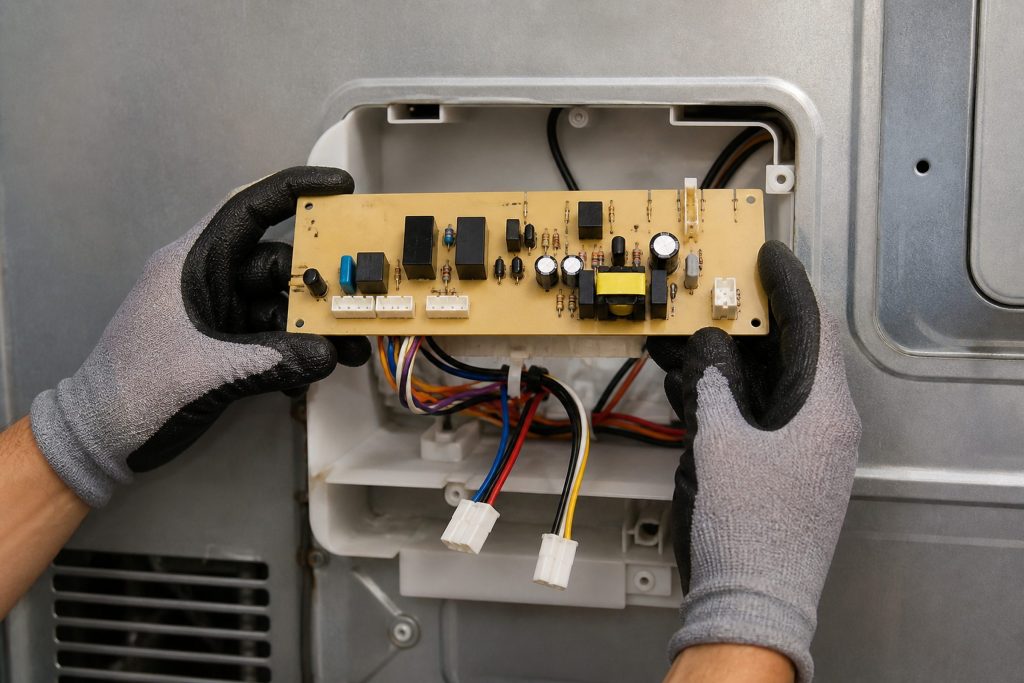
The part people reach for first and the one the maker itself says is rarely the cause. Its own manual calls the main control very robust and asks for the board to be fully diagnosed before it is removed — and then prints the flow chart to do it with. We follow that chart, because the alternative is an expensive part fitted to a problem it does not fix.
- Diagnosed the maker's way before it is condemned
- A blank display is checked as a mode first
- A new board is programmed to your model, or nothing works right
-
from $95 Diagnostic visit
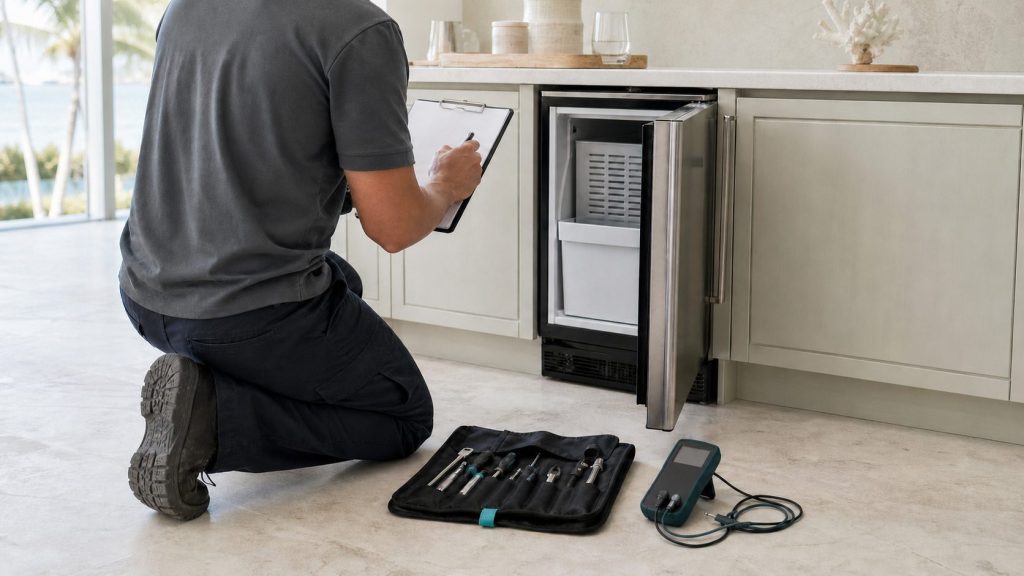
We find out what is actually wrong before anybody quotes a part. On a U-Line that starts with a question most visits skip: is the appliance reporting a problem, or is it in a mode somebody enabled by accident? A unit that lights up and will not cool is showroom mode as often as it is a sealed system, and the two are not the same conversation. The fee is credited toward the work when you go ahead.
- Modes ruled out before any part is named
- The error log read, not guessed at
- Credited toward the repair
-
from $145 Condenser and airflow service
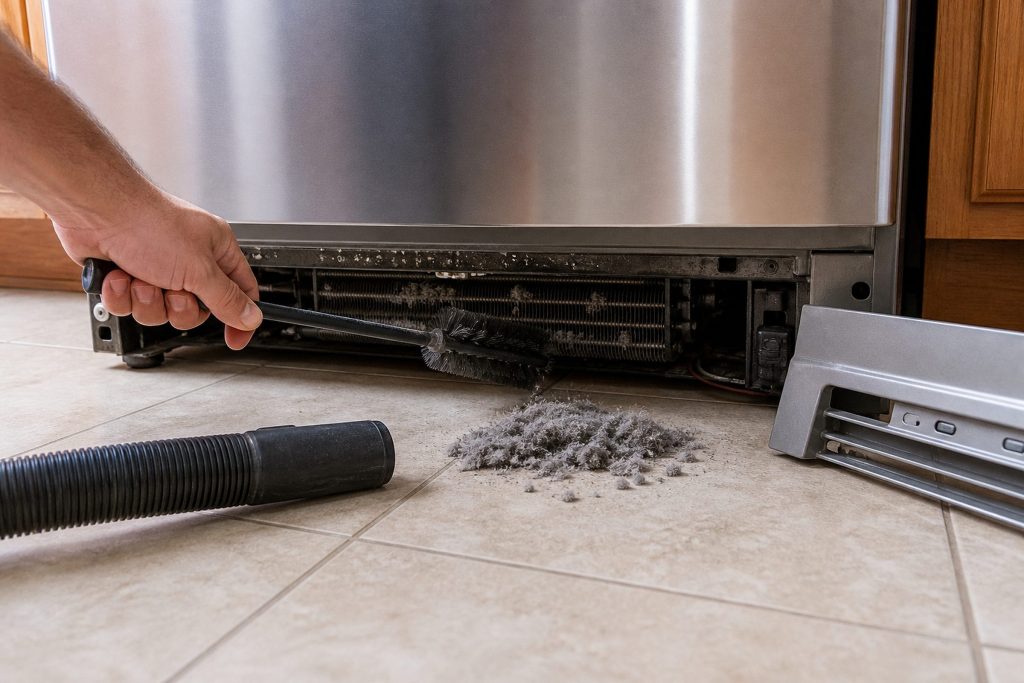
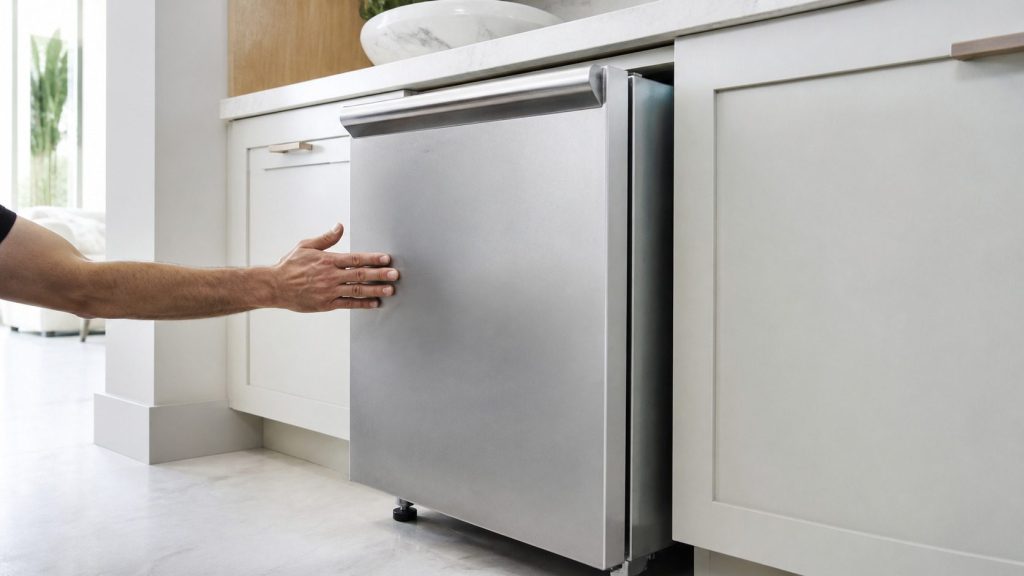
The maker's own first answer for a unit that is not cold enough is the grille and the condenser, and on an undercounter appliance it is right more often than anywhere else: the condenser sits behind a grille at floor level, in a kitchen, under a counter. It fills with dust and lint, and the unit does not complain — it just runs longer and holds less.
- The maker's own first check for "not cold enough"
- Cleaned the way the manual allows, not with a chemical
- Clearance around the unit checked, not only inside it
-
The maker names two causes, and lists what is normal Loud or unusual noise
U-Line publishes a list of what its appliances are supposed to sound like — a compressor hum, refrigerant that sounds like boiling liquid, air through the condenser, water dripping into the drain pan during defrost — and a two-line list of what makes them noisy. Between them, most of these calls are settled.
- A new noise that was not there before
- Loudest just after it starts
- A rattle rather than a hum
Questions people ask about this
Is a burning smell from a refrigerator dangerous?
An electrical one is the single symptom on this site worth acting on the same hour. It is also frequently confused with the smell of dust cooking on a warm condenser, which is not dangerous and is a sign the appliance needs a service. If you cannot tell which you have, switch it off and let somebody look — nobody sensible will think less of you.
What does an electrical burning smell actually smell like?
Sharp, acrid and chemical, with a note of hot plastic. It has a hard edge to it that dust does not. The other distinguishing feature is behavior: a dust smell fades as the unit cools and disappears after the coil is cleaned; an insulation smell keeps returning whenever the appliance runs.
Where should I switch it off?
At the breaker if the unit is built in, which nearly all of these are, because the outlet is behind the appliance and unreachable. An appliance switched off at its own control is still live at its terminal block, which is not what you want if something in there is overheating.
Could it be food rather than the appliance?
It happens — something touching a light housing or spilled onto a warm surface. That is worth ruling out because it is instantly obvious once you look. It smells of food burning rather than of plastic, and it is in one identifiable place.
Can I keep using it if the smell goes away?
If it was dust and the condenser has been cleaned, yes. If it was acrid and it went away on its own, no — something got hot enough to smell and nothing has changed except that it has cooled down. It will get hot again.
Safety & Risks
More guides like this one
-
Signs of a Refrigerant Leak — and What R600a Changes
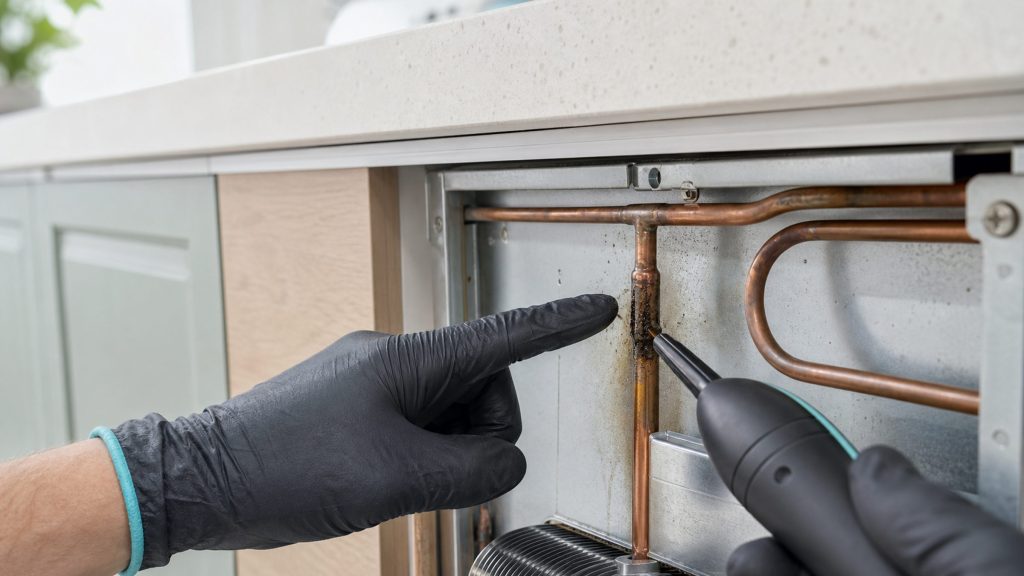
A sealed system does not use refrigerant up. If it is low, it is leaking — and the current U-Line range runs a refrigerant most people have never been told about.
Read more -
Mold on a Refrigerator Door Seal — Why It Keeps Coming Back
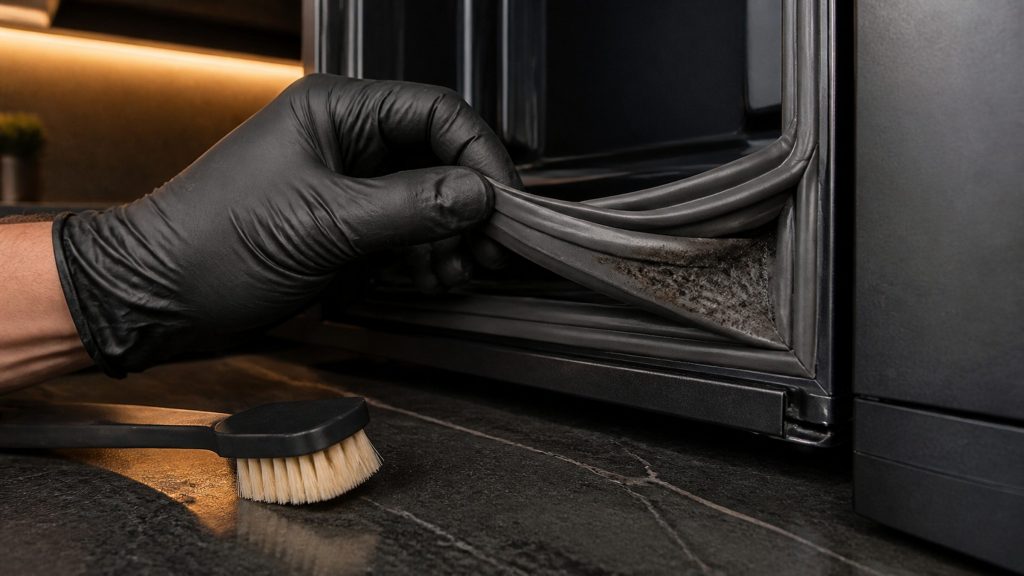
Cleaning it is easy and it returns, which is the actual question. Mold on a seal is a humidity problem with a mechanical cause, and in South Florida the humidity half is not going anywhere.
Read more -
How Long Food Lasts Without Power — and What an Undercounter Cabinet Changes
Four hours in a refrigerator, twenty-four to forty-eight in a freezer — with the doors shut. An undercounter cabinet has less of everything those numbers depend on.
Read more
Tell us the model number and what it is doing.
This article is based on:
- Official manufacturer documentation
- Internal repair procedures
- Technician repair history
- Company quality standards