Safety & Risks
Can a Refrigerator Start a Fire? What Is Actually Worth Acting On
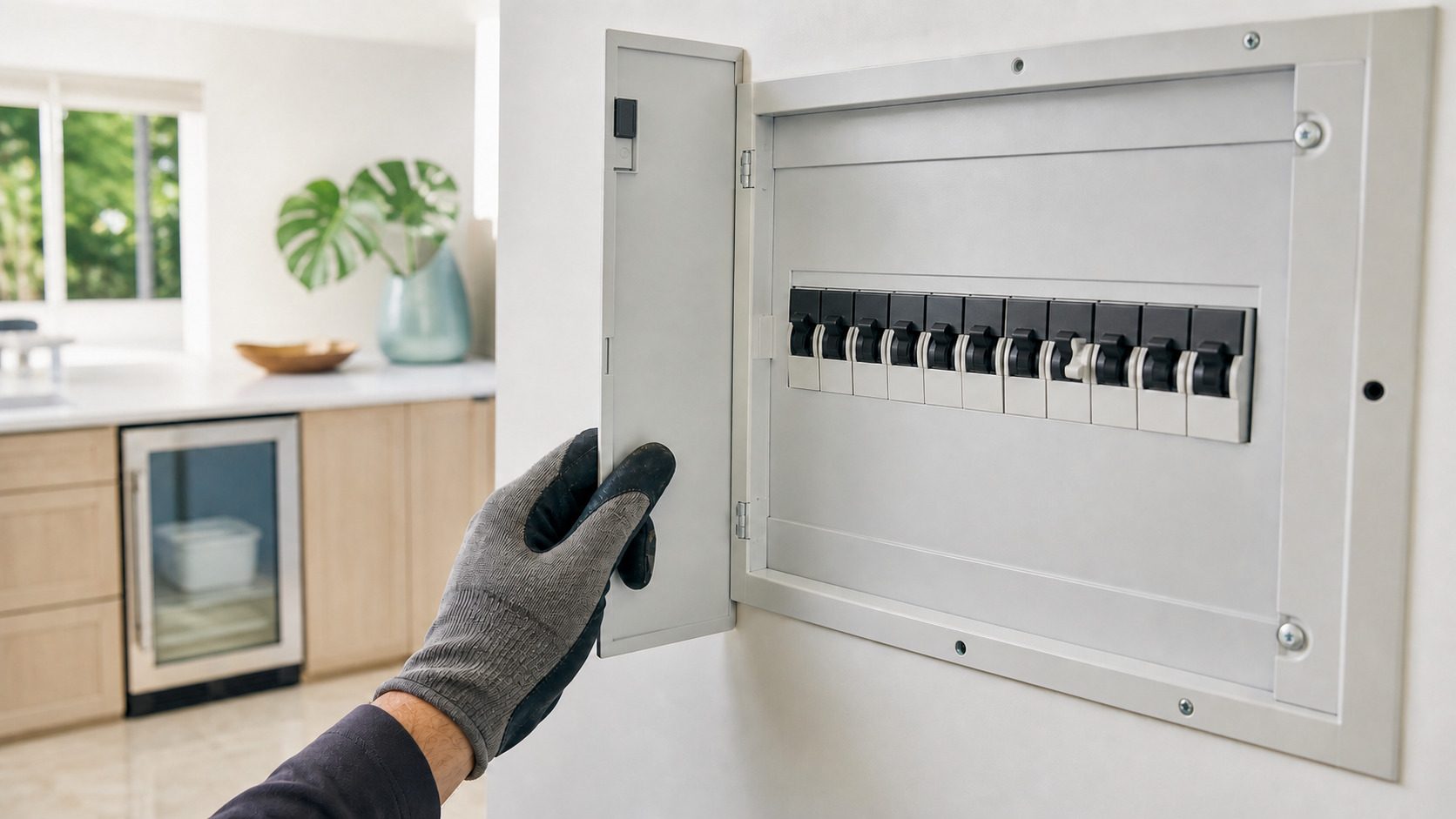
Yes, in the sense that any appliance drawing mains power can, and the realistic mechanisms are electrical rather than refrigeration: a failing start relay or capacitor on an older unit, a damaged supply cord or an overloaded extension lead, or a control board that has developed a problem at a connection. These announce themselves before they get serious — a burning or acrid electrical smell, scorch marks or discoloration at a connector, a breaker that trips repeatedly, or a compressor that is far hotter than it has been. Refrigerant is not the mechanism people imagine, though the current U-Line range uses R600a, which is flammable; the charge is small, it is contained, and the appliance is designed and certified around it. The proportionate response is not anxiety about a working appliance but a short list of things that mean switch it off at the breaker today, and a burning smell is the first of them.
The full guide
Can a refrigerator start a fire? The short answer, without drama
Yes — in the same sense that a television or a washing machine can. An appliance that draws mains power for years has electrical components in it, and electrical components fail.
What is worth doing with that fact is not worrying about a working appliance. It is knowing which handful of signs mean act now, and being able to tell them from the ones that mean nothing.
The realistic mechanisms
Start components on older designs. A relay and an overload sit beside the compressor on conventional systems and switch a substantial current on every start. They fail, sometimes hot, and they are among the more common origins in appliance fire statistics generally.
On U-Line's 5 Class this hardware is different — the compressor runs under an inverter driver, which the maker's own compressor sheet names as both starting device and overload. A driver board is a different component with a different failure mode, and the principle is unchanged: it is the electrical part rather than the refrigeration that is worth watching.
The supply. A damaged cord, a cord trapped when an appliance was pushed back into a run of joinery, a loose terminal, or an extension lead doing work it was not intended for. On a built-in appliance the outlet is behind the unit where nobody has looked at it since the kitchen was fitted, and that is worth a look during any service that involves pulling the appliance out.
A connection on the control board. U-Line's own manual asks for the main control to be fully diagnosed before it is condemned, and describes it as robust. Where boards do develop problems, it is usually at a connector carrying real current rather than in the logic.
What is not the mechanism
The refrigerant is not what people are picturing. The current U-Line range uses R600a, isobutane, which is a hydrocarbon and is flammable — a genuine and often-unmentioned fact. What makes it manageable is that the charge in an undercounter appliance is a matter of grams, the system is sealed, and the appliance is designed and certified around exactly that.
Where R600a changes something practical is who may open the system. Sealed-system work on a hydrocarbon charge is licensed work with the right equipment and the right procedure, and it is not a job for somebody with a spare afternoon.
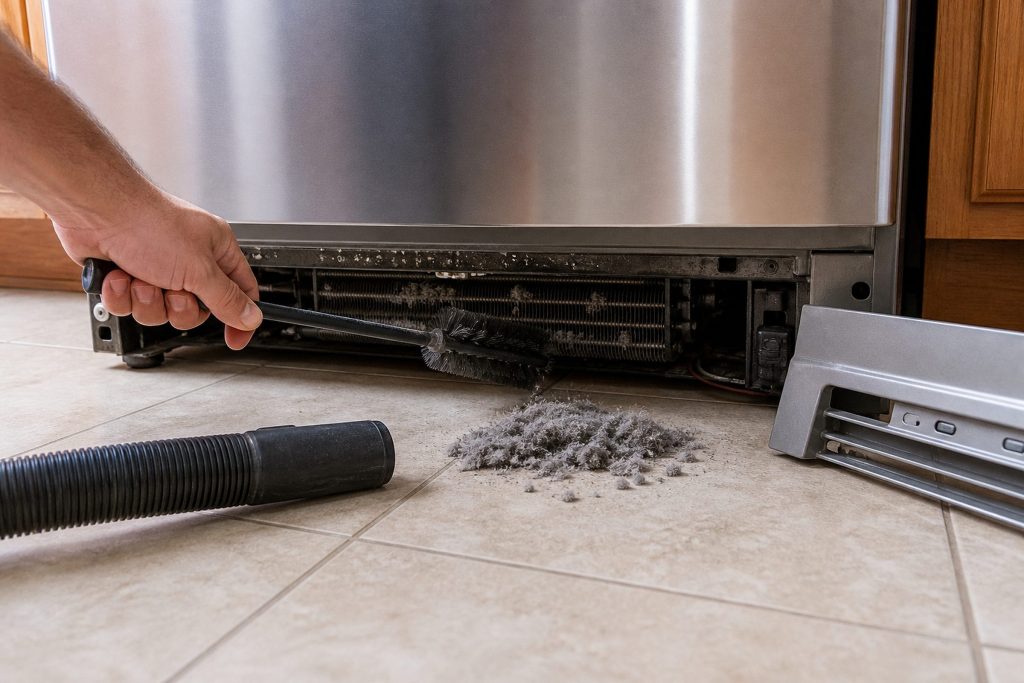
A dirty condenser is not going to set fire to your kitchen. It will make the appliance run longer, cost you compressor life and produce a warm smell of dust. Worth cleaning. Not worth alarm.
The four things that mean switch it off today
- A burning, acrid or sharp electrical smell. Insulation. Not dust.
- Scorching or discoloration at a plug, an outlet, a terminal block or a connector.
- A breaker that trips repeatedly when the appliance starts. A breaker is doing its job; resetting it over and over is overruling it.
- A compressor or a machine compartment that is dramatically hotter than it has ever been, together with anything else on this list.
Switching off means at the breaker or the plug, not at the appliance's own power button. A unit switched off at its control is still live at the terminal block.
Telling a burning smell from a warm one
The distinction is worth having because both arrive as *"my refrigerator smells like it is burning"*.
Dust on a warm condenser smells dry and dusty, like a heater at the start of winter. It appears when a unit has been running hard, and it goes away after the coil is cleaned. It is a maintenance job.
Insulation smells sharp, acrid, chemical, and slightly like burnt plastic. It does not fade with running. It is the one on the list above.
If you are not sure which you have: switch it off at the breaker, let it cool, and call somebody. Nobody sensible will think less of you for it.
The proportionate version
Most refrigerators run for fifteen years and set fire to nothing. The things that reduce what small risk there is are unglamorous: keep the condenser clean so the machine is not working harder than it needs to, do not run an appliance from an extension lead, get a repeatedly tripping breaker looked at rather than reset, and treat a burning smell as the one symptom that does not wait until Monday.
If it turns out to be a repair
What this leads to, and what it costs
Every job on this site is priced the same way: an on-site diagnostic first, the figure agreed in writing before anybody starts.
-
from $245 Control board and display repair
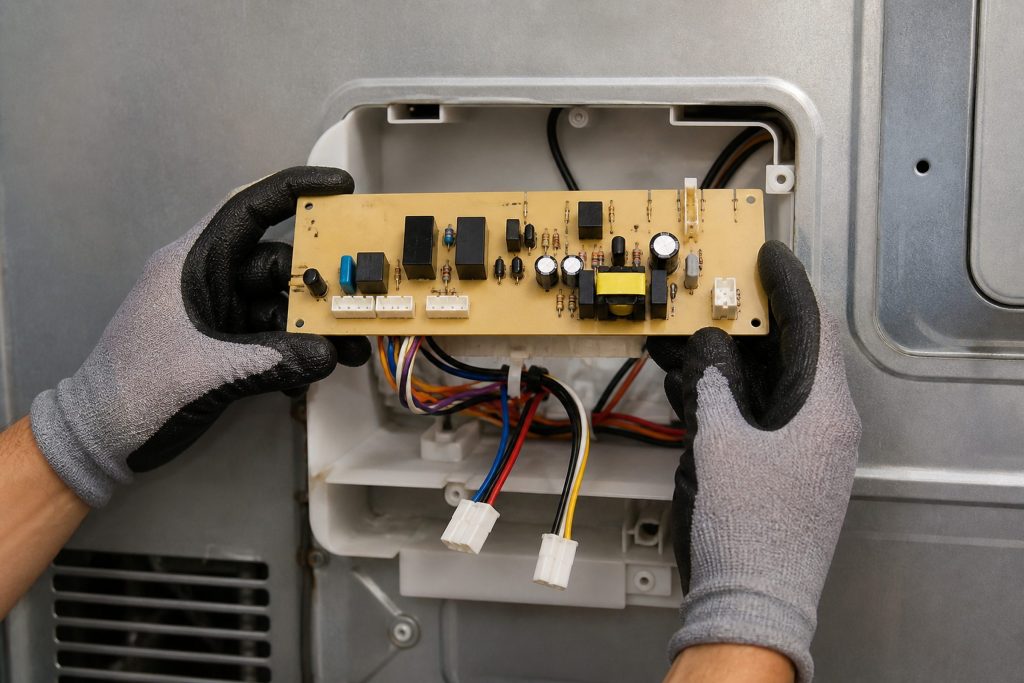
The part people reach for first and the one the maker itself says is rarely the cause. Its own manual calls the main control very robust and asks for the board to be fully diagnosed before it is removed — and then prints the flow chart to do it with. We follow that chart, because the alternative is an expensive part fitted to a problem it does not fix.
- Diagnosed the maker's way before it is condemned
- A blank display is checked as a mode first
- A new board is programmed to your model, or nothing works right
-
from $95 Diagnostic visit
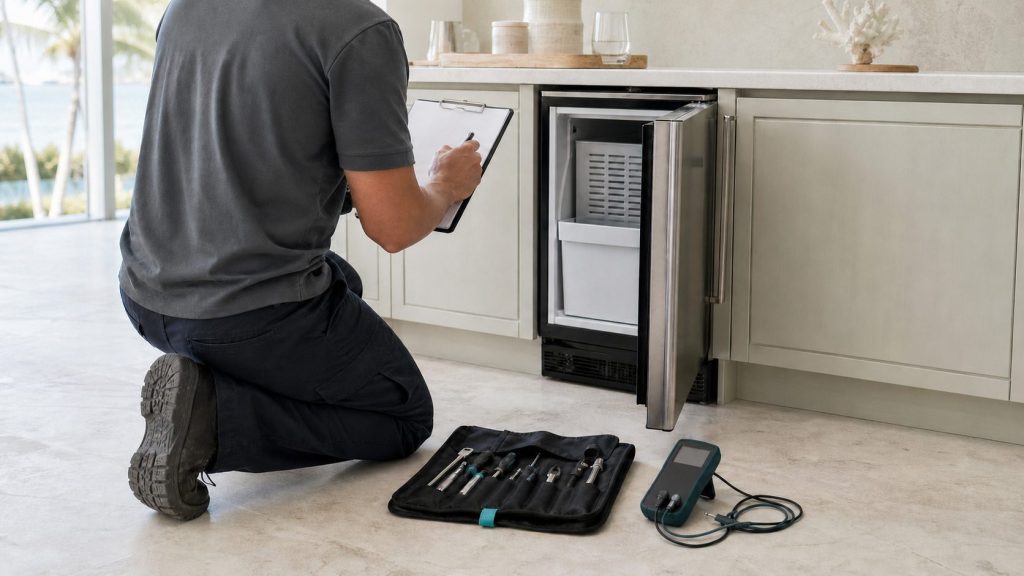
We find out what is actually wrong before anybody quotes a part. On a U-Line that starts with a question most visits skip: is the appliance reporting a problem, or is it in a mode somebody enabled by accident? A unit that lights up and will not cool is showroom mode as often as it is a sealed system, and the two are not the same conversation. The fee is credited toward the work when you go ahead.
- Modes ruled out before any part is named
- The error log read, not guessed at
- Credited toward the repair
-
The maker names two causes, and lists what is normal Loud or unusual noise
U-Line publishes a list of what its appliances are supposed to sound like — a compressor hum, refrigerant that sounds like boiling liquid, air through the condenser, water dripping into the drain pan during defrost — and a two-line list of what makes them noisy. Between them, most of these calls are settled.
- A new noise that was not there before
- Loudest just after it starts
- A rattle rather than a hum
-
from $145 Condenser and airflow service
The maker's own first answer for a unit that is not cold enough is the grille and the condenser, and on an undercounter appliance it is right more often than anywhere else: the condenser sits behind a grille at floor level, in a kitchen, under a counter. It fills with dust and lint, and the unit does not complain — it just runs longer and holds less.
- The maker's own first check for "not cold enough"
- Cleaned the way the manual allows, not with a chemical
- Clearance around the unit checked, not only inside it
Questions people ask about this
Can a refrigerator compressor start a fire?
The compressor itself is a sealed motor in a steel shell and is an unlikely origin. What sits beside it on older designs is more relevant: a start relay and an overload, which are electrical components that can fail hot. On newer U-Line units the 5 Class uses an inverter driver instead, which changes the components but not the principle — electrical parts fail electrically.
Can a refrigerator that is switched off start a fire?
Not while it is genuinely disconnected. An appliance switched off at its own control is still live at the terminal block, which is why the instruction on this page is to switch it off at the breaker or unplug it rather than to press the power button.
Is a burning smell from a refrigerator dangerous?
It is the one symptom on this site worth acting on the same hour. Distinguish it from the smell of dust on a warm condenser, which is dry and dusty and fades after a service. An acrid, sharp, plastic or electrical smell is insulation, and that is a switch-off-now situation.
Is R600a refrigerant dangerous?
It is a hydrocarbon and it is flammable, which is a genuine difference from older refrigerants. The charge in an undercounter appliance is very small, the system is sealed, and units are designed and certified for it. What it changes in practice is who may open the system: it is licensed work, and it is not a job for a general handyman.
My breaker trips when the fridge starts. Is that a fire risk?
It is a real electrical problem and it should not be reset repeatedly. A breaker doing its job is protecting a circuit from something, and the something is worth finding — a failing start component, a damaged cord, or a shared circuit that is overloaded.
Safety & Risks
More guides like this one
-
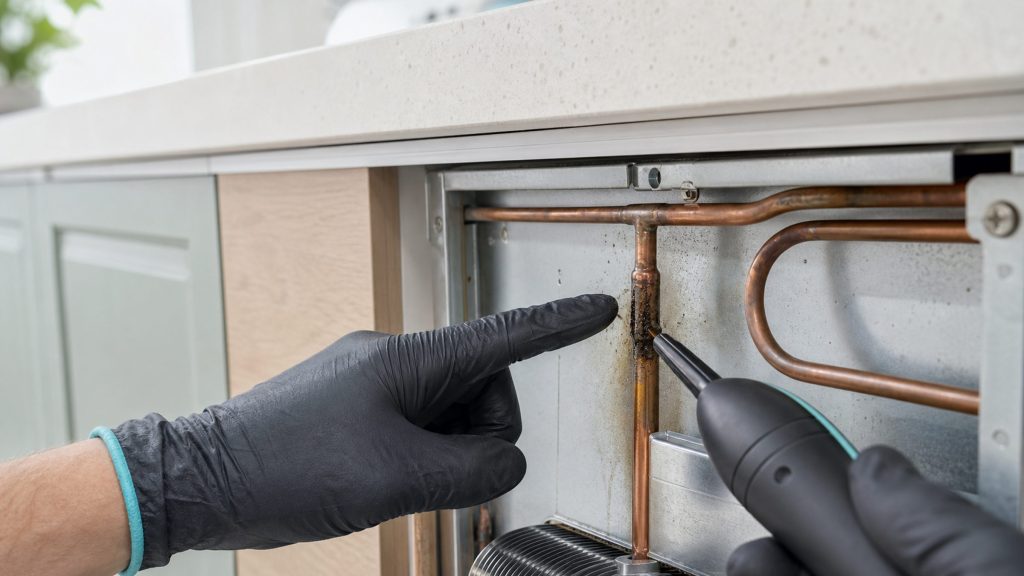
Signs of a Refrigerant Leak — and What R600a Changes
A sealed system does not use refrigerant up. If it is low, it is leaking — and the current U-Line range runs a refrigerant most people have never been told about.
Read more -
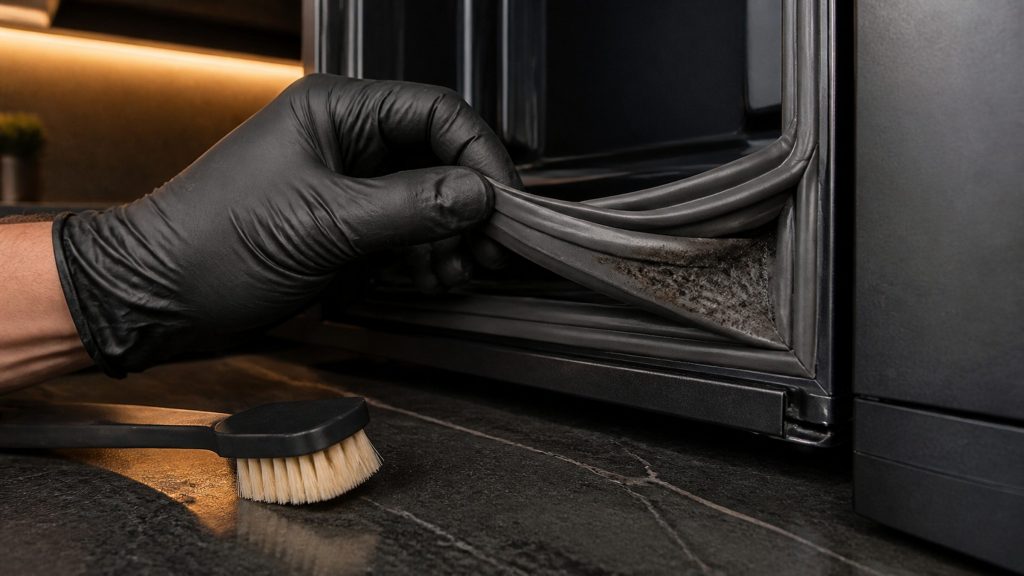
Mold on a Refrigerator Door Seal — Why It Keeps Coming Back
Cleaning it is easy and it returns, which is the actual question. Mold on a seal is a humidity problem with a mechanical cause, and in South Florida the humidity half is not going anywhere.
Read more -
How Long Food Lasts Without Power — and What an Undercounter Cabinet Changes
Four hours in a refrigerator, twenty-four to forty-eight in a freezer — with the doors shut. An undercounter cabinet has less of everything those numbers depend on.
Read more
Tell us the model number and what it is doing.
This article is based on:
- Official manufacturer documentation
- Internal repair procedures
- Technician repair history
- Company quality standards