Troubleshooting
Your U-Line Is Keeping an Error Log You Cannot See
U-Line's control logs its errors in memory and shows only the door error on the display, with an audible signal — that sentence is printed in every manual the company publishes with a code table. So the fifteen numbers this control knows are real, they are the maker's own, and unless yours is a door you will never see one on the front of the appliance. They live in a service menu: the hidden button held for ten seconds, then option 14 on the older boards or 21 on the current ones, and the errors scroll in the order they happened. Two things follow from that. Searching for a code you cannot see is not a failure of your searching. And clearing the log — which is the entry right next to it in the same menu — deletes the sequence, which is the most useful thing anybody would have had to work from.
The full guide
U line error codes: the sentence that changes everything
It is in every U-Line User Guide & Service Manual that carries a code table, in the same words:
> All errors are logged in memory. Only door error is displayed on the display and has an audible signal.
Read slowly, that says three things at once. The appliance detects errors. It writes them down. It will not tell you about any of them except a door left open.
Which is why the search for U-Line error codes returns so little of substance. It is not that the codes do not exist — there are fifteen of them and they are printed in the maker's own manuals. It is that almost nobody has ever seen one on a display, because the display is not where they go.
Where they actually go
Into a service menu, reached the same way on every model that has one: hold the hidden button for ten seconds. The display shows 0. From there the up and down arrows move through numbered parameters and the light key selects.
The log is option 14 on the older boards — the 1 Class, the 5 Class, the ice machines, the 2000 Series — and option 21 on the current Home and Seamless controls. Selecting it scrolls the errors in the order they occurred.
The entry immediately after it, 15 or 22, clears the log. Those two being next to each other in the same list is worth knowing before you start pressing things.
What is on the list
| Logged as | The maker's own wording |
|---|---|
| E0 | Door 1 (upper) open |
| E1 · E2 · E3 | Thermistor 1, 2 and 3 open |
| E5 · E6 · E7 | The same three sensors, shorted |
| E9 | Door 2 (lower) open |
| E10 | Door 2 open — shown on the display as 10 |
| E11 · E12 | Water level high, water level low — shown as 11 and 12 |
| E13 | Auger error — shown as 13 |
| P1 | Drain pump circuit open, only if the unit has a drain pump |
Four of those — 10, 11, 12 and 13 — are the exception to the rule above: on the ice machines they do reach the display, as bare digits. That is exactly why uline ice machine flashing 11 is a real search and u line error code e11 is barely one. People are reading a number off a panel and it does not look like a code, so they do not search for it as one.
The honest caveat, and it matters on this brand
U-Line prints its numbers twice, and the two lists do not mean the same thing.
Troubleshooting Extended carries the control platform's list — every number the board is capable of logging. The manual for a solid-door 24-inch refrigerator carries E13: Auger error in that list, and that refrigerator has never had an auger in its life.
The service-menu guide carries that model's own list, and writes *"Does not apply to this model"* against the numbers the unit cannot raise.
Reading the first as though it were the second is precisely how a sibling repair-guide network ended up publishing around thirty-eight U-Line "codes" that were really plain-English symptoms. It is the reason this site keeps the two lists apart and marks the five numbers no model's own menu claims.
Why clearing it before a visit is expensive
The log's value is not the individual numbers. It is the sequence.
A thermistor error on its own says a sensor circuit failed. A door error at 6 p.m. followed by a thermistor error at 6 a.m. says something rather different — a door left open overnight, a cabinet that fought it, and condensation somewhere it should not be. Same two numbers, entirely different afternoon.
Clearing the log takes five seconds and turns the second story back into the first. On an appliance that will not tell you anything else, that is a real loss.
What to do with all this
If you are calling somebody: do not clear it, and say on the phone that you have not. It is a better piece of information than most people arrive with.
If you are diagnosing it yourself: read the log, write the numbers down in order, and then treat them as a pointer rather than an answer. E5 tells you the cabinet sensor is reading short. It does not tell you whether it is the sensor, the harness, or the connector that U-Line greases at the factory precisely because corrosion changes what the board sees.
And if your manual sends you to an Appendix D that is not in the document, that is the current 3 and 4 Class boards and it is not your copy. Those machines keep the log and the maker does not publish the decoder — which is a fact about the appliance rather than a gap in what anybody knows, and it is why on those the answer is measurement rather than lookup.
If it turns out to be a repair
What this leads to, and what it costs
Every job on this site is priced the same way: an on-site diagnostic first, the figure agreed in writing before anybody starts.
-
U-Line error code E5
U-Line error code E5: Thermistor 1 shorted. In plain terms, the cabinet sensor — the one reading the compartment you keep things in, and the control has lost it. Which machines can actually raise it, where the number lives on this make, and what to do next.
What this one means -
U-Line error code E0
U-Line error code E0: Door 1, the upper door on a two-door unit and the only door on everything else, has been open longer than the control accepts. Which machines can actually raise it, where the number lives on this make, and what to do next.
What this one means -
U-Line: The display shows ER, or E and a number
U-Line — an indicator rather than a code. On the 2000 Series the maker answers this in the front of the book rather than in the service section, and the answer is short: E3 indicates the door may have been open too long, ensure the door is closing properly, and for other error codes contact customer service.
What the machine is telling you -
Diagnostic visit
We find out what is actually wrong before anybody quotes a part. On a U-Line that starts with a question most visits skip: is the appliance reporting a problem, or is it in a mode somebody enabled by accident? A unit that lights up and will not cool is showroom mode as often as it is a sealed system, and the two are not the same conversation. The fee is credited toward the work when you go ahead.
- Modes ruled out before any part is named
- The error log read, not guessed at
- Credited toward the repair
Questions people ask about this
Why can I not find my U-Line error code anywhere?
Because most of them are never displayed, so almost nobody has ever seen one to write about. If you are looking at a bare number on an ice machine it is probably 11, 12 or 13, which U-Line prints as E11, E12 and E13 and notes are shown as digits. If it is ER followed by a number, you have a 2000 Series cabinet, and the maker's own answer for that is the door.
Can I read the log myself?
Physically, yes — the sequence is published. Whether it is useful is another matter, because the numbers name sensor and door errors rather than giving instructions, and knowing that thermistor 2 went open does not tell you whether it is the sensor, the harness or the connector. The value of reading it is that it points at a sensor rather than at a sealed system, and those are two different orders of money.
What are HTA and PF on a U-Line?
Not U-Line codes. They trace back to Frigidaire and Electrolux documentation and appear in none of the forty-four U-Line manuals archived for this site. HH is in the same position: people search for it, no U-Line manual prints it. We do not publish any of the three.
My manual points at an Appendix D that is not there.
That is the current Home and Seamless collections, and it is not your copy that is missing pages. Service-menu item 21 reads Error Log (See Appendix D) and no appendix follows. Those machines keep a real log the maker does not decode in print, so on them the diagnosis is the log plus measurements rather than a lookup.
Should I clear the log after a repair?
After a repair, yes — a log full of old errors makes the next one harder to read. Before a repair, no. The order matters: a door error followed by a thermistor error is a different story from a thermistor error on its own.
Troubleshooting
More guides like this one
-
The Light Works, the Display Works, and Nothing Is Cold
On most refrigerators this points at the compressor. On a U-Line, check the degree symbol first — there is a setting that runs the display and the light and switches the cooling off entirely.
Read more -
How to Reset a U-Line — and Why There Is No Reset Button
There is no reset button on a U-Line. What exists is a power cycle, two modes people mistake for a failure, and a service menu — and one of those choices destroys the only evidence the appliance kept.
Read more -
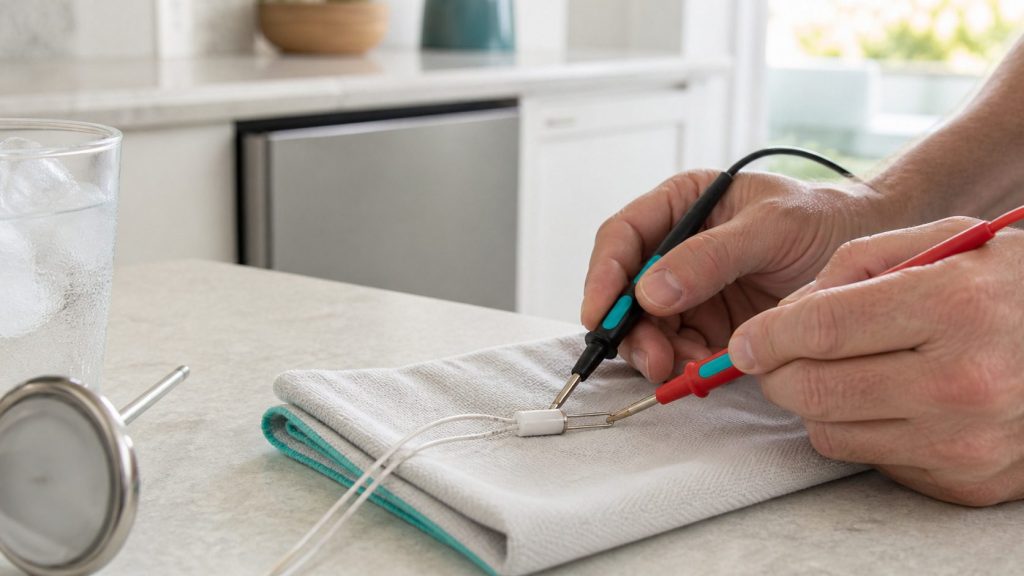
How to Test a Refrigerator Thermistor — With the Maker’s Own Number
U-Line publishes the figure: about 16.1k ohms in an ice-water bath, within five percent. That turns a guess into a measurement, and on this make it is the first thing worth measuring.
Read more
Tell us the model number and what it is doing.
This article is based on:
- Official manufacturer documentation
- Internal repair procedures
- Technician repair history
- Company quality standards