U-LineRepair Miami

27 numbers · 11 signals · two systems that do not share a language

U-Line error codes, and where they actually live.

Most of this make writes the same sentence in every manual it prints: all errors are logged in memory, and only the door error is displayed and has an audible signal. The 3000 Series is the exception and it is the opposite — it monitors continuously and puts a notification in plain words on the user interface. So before you look anything up, it matters which of the two you own: on one you are reading a hidden log, on the other the cabinet is telling you.

  • 15 numbers on the E platform, each from a manual
  • 12 notifications the 3000 Series shows you
  • 11 documented signals, quoted
  • 5 on the board's list and no model's menu

Search the archive

Type what the display is showing

Partial entries work. On this make most numbers never reach a display at all, so if yours is a bare digit off an ice machine try 11, 12 or 13 — and if the appliance is showing you nothing, describe what it is doing and start from the signals instead.

Nothing here is invented. Every entry names the manual it came from, and the five numbers that sit on the control board's list without any model claiming them say so on their own pages.

The thing that makes this archive different

U-Line prints its numbers twice, and the lists disagree.

Troubleshooting Extended carries the control platform’s list — every number the board can log, whether or not the machine in front of you has the part. The manual of a solid-door 24-inch refrigerator carries E13: Auger error that way, and that refrigerator has never had an auger.

The service-menu guide carries that model’s own list and writes “Does not apply to this model” against what the unit cannot raise. Reading the first as if it were the second is exactly how a sibling network published about 38 U-Line “codes” that were really symptoms. Both lists are kept apart here, and the five numbers no model’s menu claims say so on their own pages.

What each repair costs
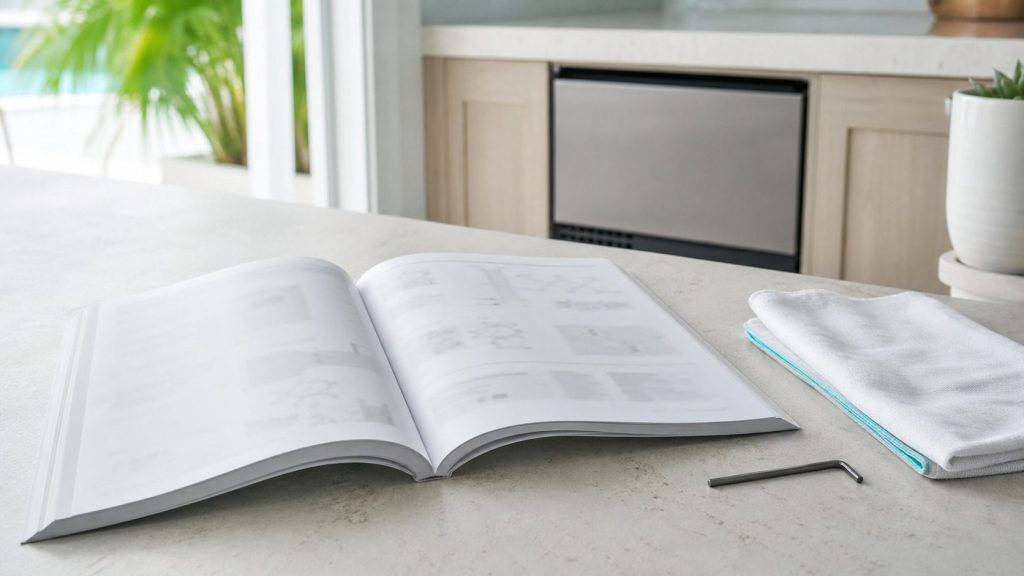
An open service manual lying face up on a pale stone worktop beside a folded cloth and a hex key, the pages shown at a shallow angle so no word can be read, soft daylight from the left.

The series that does the opposite

The 3000 Series tells you, in words, on the display.

Four cabinets in this catalog do not use the E numbers at all. The 3000 Series monitors its inputs continuously and writes a notification on the user interface in plain language: No Comm, Zone T Open, Amb Thrm Short, Temp Hi 12H+, Door Open 5M. Twelve of them, each with the maker’s own solution beside it, and on a two-zone cabinet each says (L) or (R) so you know which half it came from.

That is the reverse of every other U-Line ever built, and it is why the first question on this archive is which series you own rather than what the display says. Two of the twelve — Evap T Open and Evap T Short — appear only in the service guide and in no customer-facing table at all.

What your appliance is doing
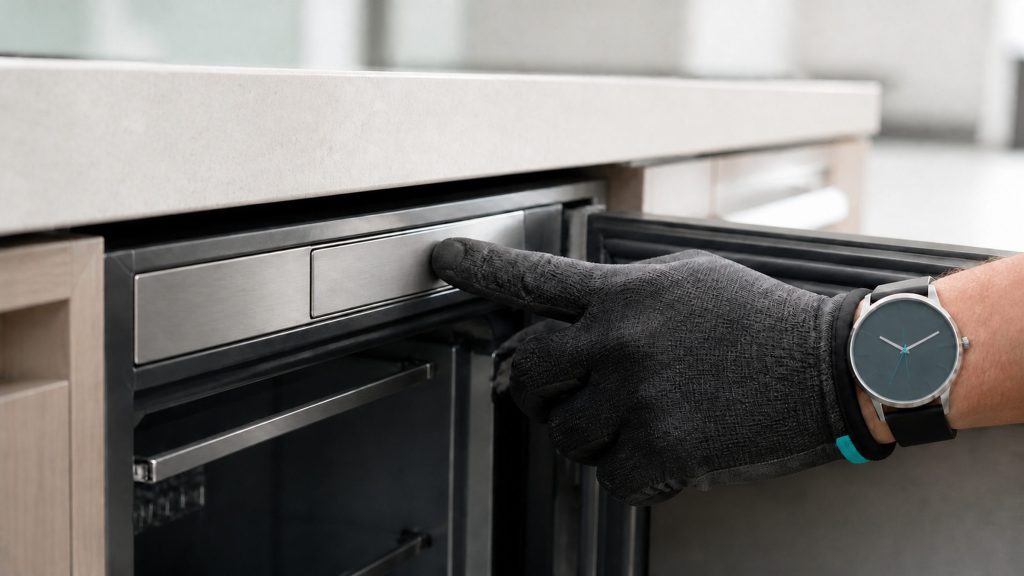
A gloved fingertip held down on one unmarked key of a blank brushed control strip inside an appliance door, a wristwatch just in frame showing the seconds hand, no characters anywhere, close and shallow.

If you have a number

Four things to do before it clears

Write it down exactly

  • The string as shown — E5, or a bare 11, or ER and a digit.
  • Photograph it. On this make what you can see is worth more than usual.
  • Do not clear the log: the order errors happened in is evidence.

Establish what kind of thing it is

  • A door error is on the display and sounds every minute.
  • A bare 11, 12 or 13 on an ice machine is water or the auger.
  • A number between 1 and 16, or 99, is a test mode rather than an error.

Then the plate

  • Model and serial from the upper right or rear wall inside.
  • The control's own two-digit model number, if it has been replaced.
  • Whether the unit is 1 Class, 5 Class, Home, Seamless or 2000 Series.

Nothing on the display, which is usual here

Then start from what the cabinet is doing

This maker logs its errors in memory and shows you only the door, so on most U-Line units the behaviour is the whole of the evidence. Twenty-two pages describe what an owner can actually see — ice that stops, a cabinet that runs and never arrives, a padlock — and each opens with the checks that cost nothing.

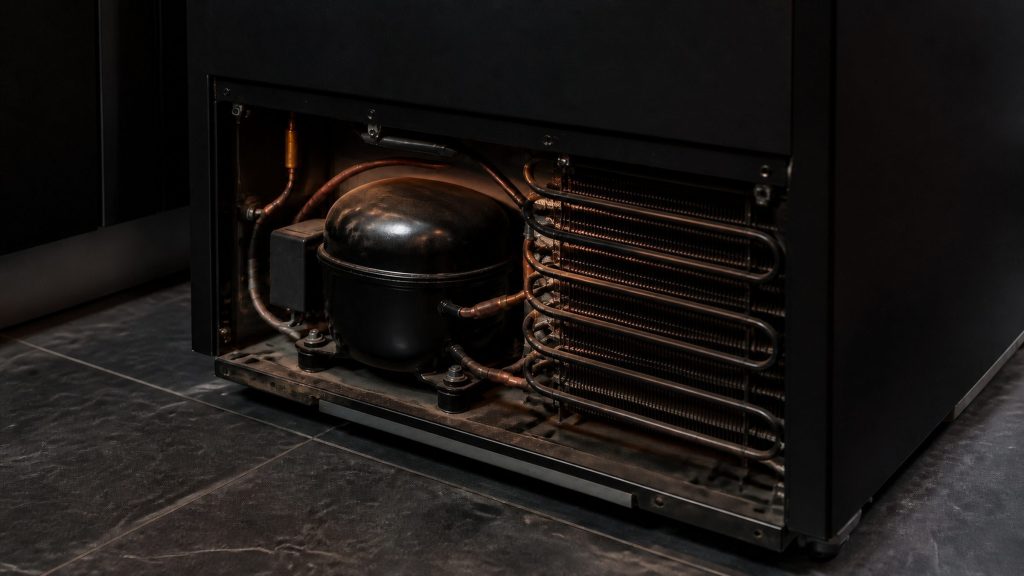
  • A refrigeration compressor and condenser tubing at the back of a cabinet, warm from running, seen in a dim service light with the cabinet pulled forward
    It hums, it lights up, and nothing is cold

    Not cooling but still running

    The most common call on this make and the one with the cheapest answer hiding inside it. Before anything is opened, two modes have to be ruled out — one of them lights the display, works the light and deliberately stops the refrigeration.

    • Running, lit, and warm inside
    • Started after a move or a delivery
    • Everything looks normal except the temperature
    What it usually means
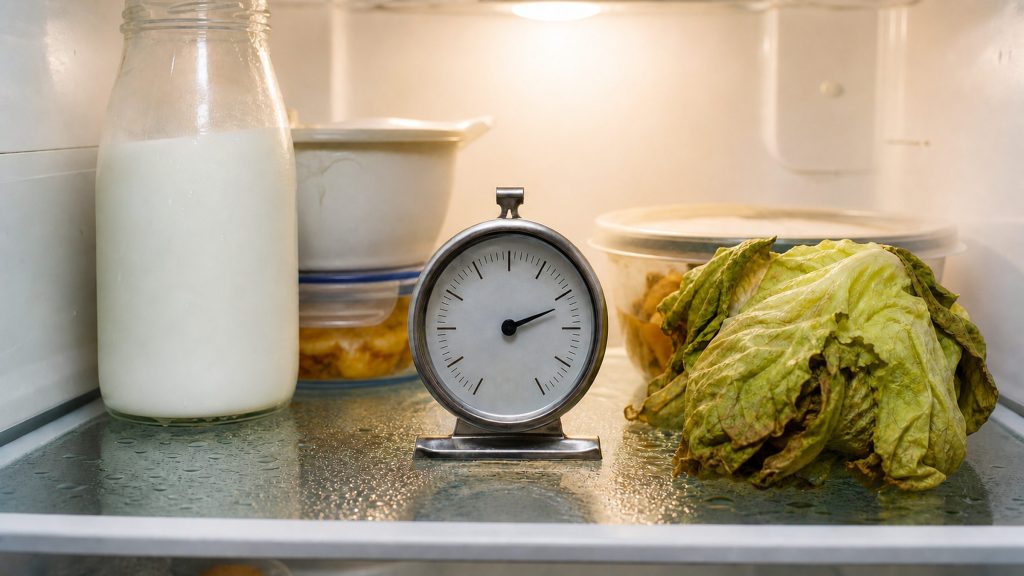
  • The lit interior of a refrigerator: a bottle of separated milk, covered dishes, a limp lettuce, a dial thermometer in the middle, water beaded on the shelf
    It works, but it never quite arrives

    Not cold enough

    A cabinet that is cold, but not at its set point, and never has been since something changed. On this make that pattern has a specific and documented cause that shows nothing on the display, which is why it gets lived with for months.

    • A few degrees out, all the time
    • Worse when the kitchen is warm
    • Runs longer than it used to
    What it usually means
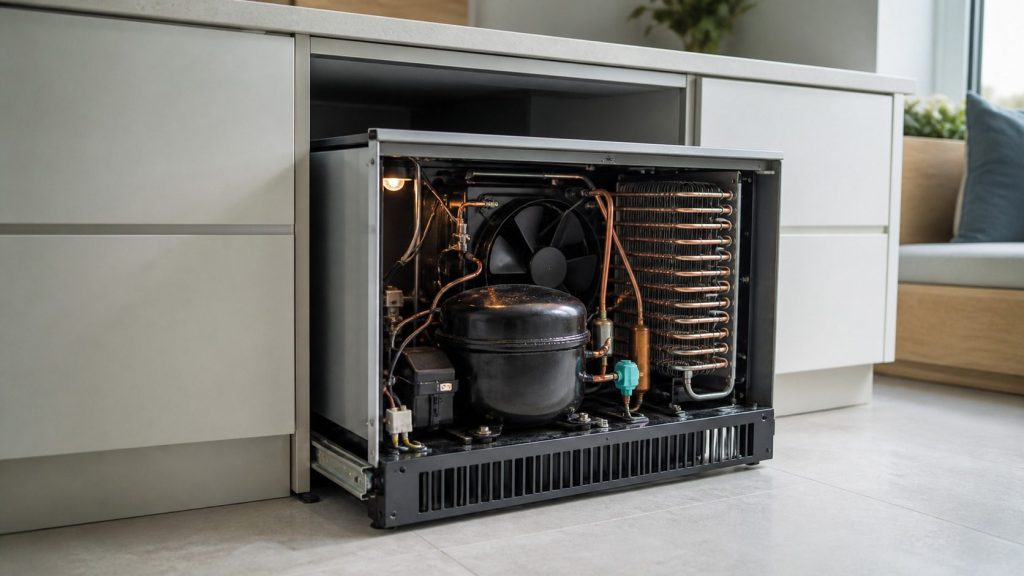
  • A compressor and its condenser tubing in the machine compartment of an undercounter cabinet, seen in a dim service light with the unit pulled forward, the fan blade caught still and the metal warm from running.
    Ten minutes on, forty minutes off, over and over

    It cycles on and off in a strange rhythm

    This one is worth its own page because the rhythm is a diagnosis. U-Line publishes the numbers: when a zone sensor fails, a 2000 Series unit runs ten minutes on and forty minutes off, whatever the cabinet actually needs, and says nothing about it.

    • A fixed rhythm that ignores the load
    • Nothing on the display
    • Started suddenly rather than gradually
    What it usually means
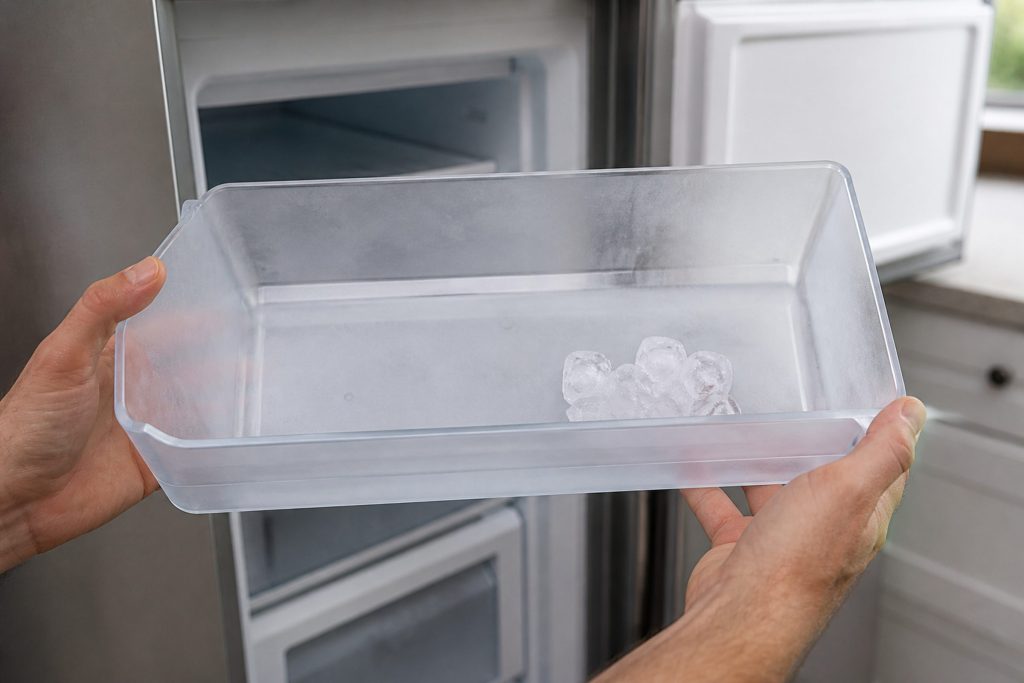
  • An empty ice bin pulled out and held level, a few loose cubes fused into a lump in one corner and the rest bare plastic
    Water in, harvest, water out — in that order

    Ice maker not making ice

    The most searched thing about this make by a wide margin. Almost every cause is on the water side rather than the cold side, and the first three checks cost nothing and are the answer more often than everything else put together.

    • Stopped completely
    • Making less and less over weeks
    • Freezing water but never dropping it
    What it usually means
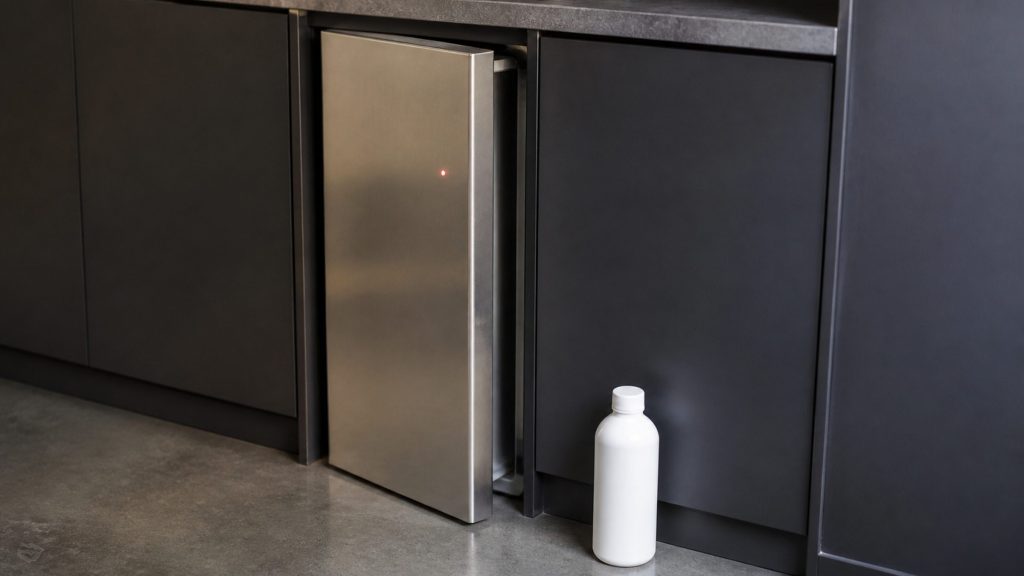
  • A narrow stainless door ajar in dark cabinetry with one small red light on the blank fascia, a plain white bottle on the floor beside it
    Nothing on the panel, or nothing after it

    Ice maker will not turn on

    A machine that shows no sign of life is a power question before it is a repair, and the maker publishes the order to ask it in. Two of the four checks need nothing but a screwdriver and none of them involves a part.

    • Dark panel
    • Panel lit but nothing happens
    • Started after a power cut
    What it usually means
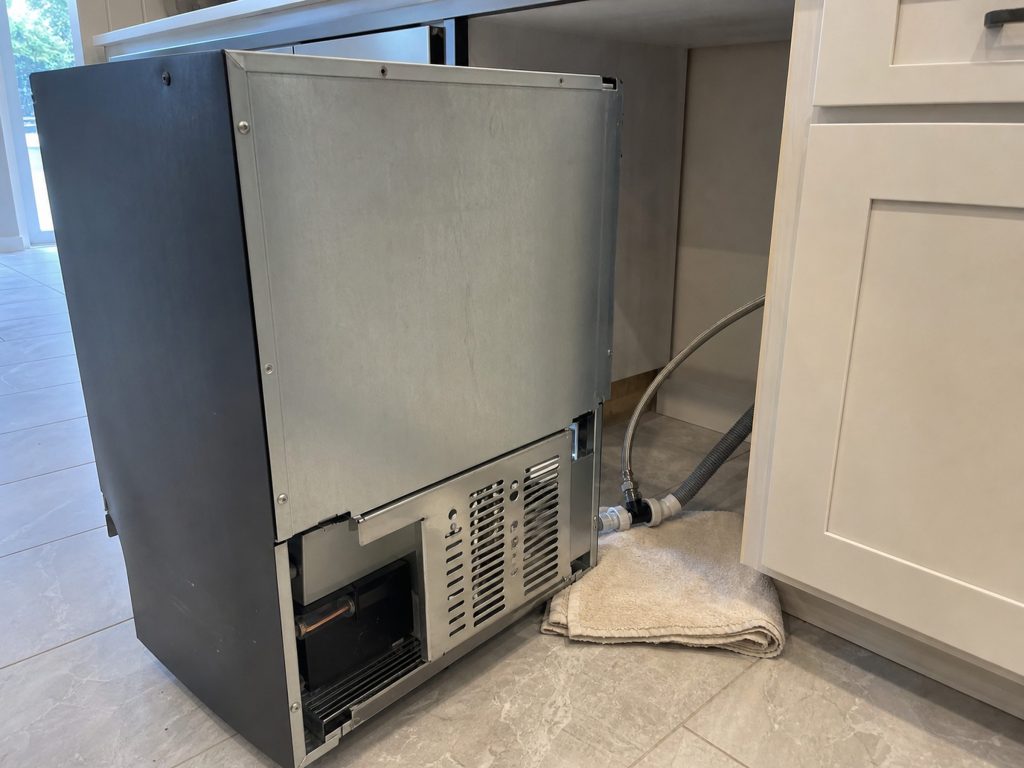
  • The back of an undercounter ice maker pulled forward on the floor, the water line and the drain pump hose visible behind it, a towel under the joint
    Where the water goes matters as much as where it comes from

    Ice maker not draining

    Standing water in the bin, water under the unit, or a machine that stops with a full reservoir. Half the diagnosis is a question nobody asks first: does this installation have a drain pump at all, or does it run to a gravity drain?

    • Water standing in the bin
    • Water on the floor under the unit
    • The drain lamp lit constantly
    What it usually means
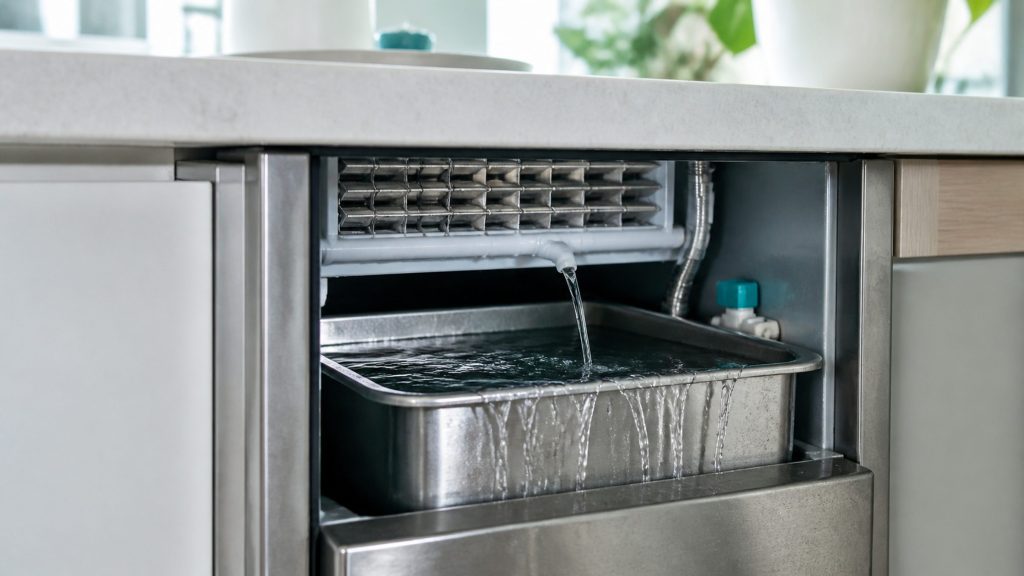
  • A thin clear stream of water running continuously into the overfull water trough of an ice machine and spilling over its lip, the evaporator grid above, cold light across the stainless.
    A fill that never ends

    The ice maker keeps taking water

    A machine that fills continuously, overflows, or keeps its inlet valve open is doing something with a short list of causes — and one of them will damage a kitchen faster than it damages the appliance, so it is worth acting on the same day.

    • Water running constantly
    • Overflowing the reservoir
    • Wet floor with the machine otherwise working
    What it usually means
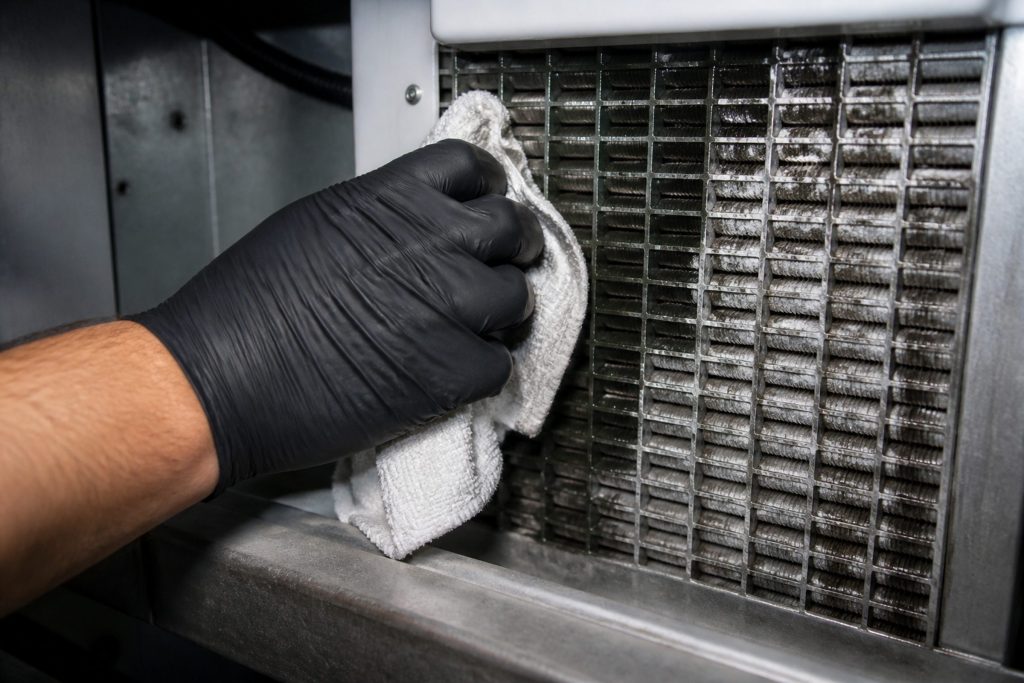
  • A gloved hand wiping a frosted evaporator plate inside a freezer compartment
    Ice where the machine did not intend it

    The ice maker is freezing up

    A block instead of cubes, ice bridging the mold, a bin frozen into one lump, or an evaporator growing a coat. Different machines fail this way for different reasons, and the shape of the ice is the clue.

    • A solid block instead of cubes
    • Ice bridging across the mold
    • Frost building where there was none
    What it usually means
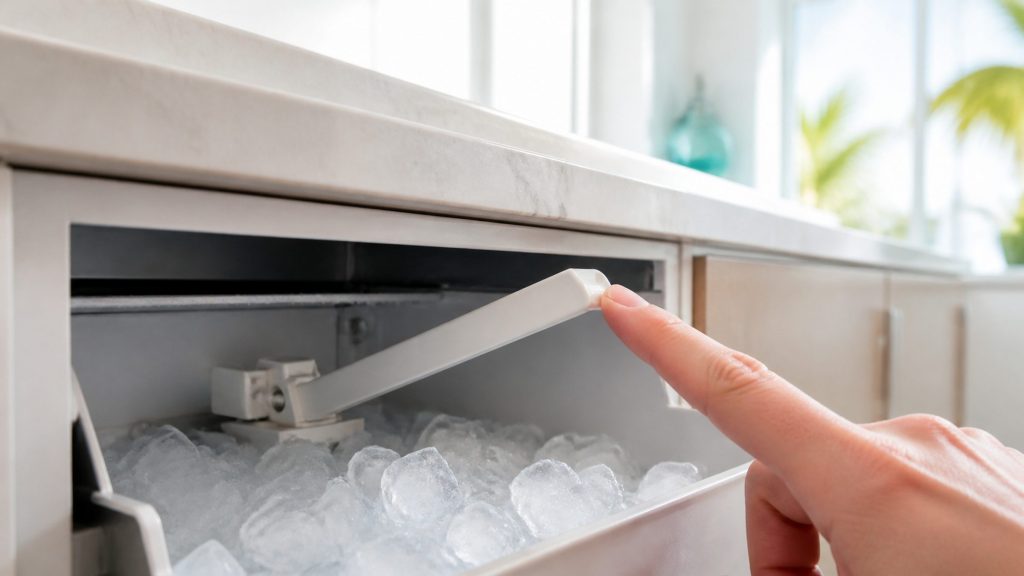
  • A close view of the white plastic bin-level sensor arm of an ice maker standing raised at an angle above a part-filled bin of cubes, a fingertip just touching it, shallow focus.
    Told it is full when it is empty

    The ice maker arm will not stay down

    One of the most searched things about U-Line's crescent makers, and it is not a metaphor: the bin arm is how a mechanical ice maker knows to stop. An arm that rests up is a machine that has been told the bin is full, and it will sit there indefinitely being perfectly healthy.

    • The arm rests in the up position
    • No ice, no error, no noise
    • Started after the bin was emptied or the machine was moved
    What it usually means
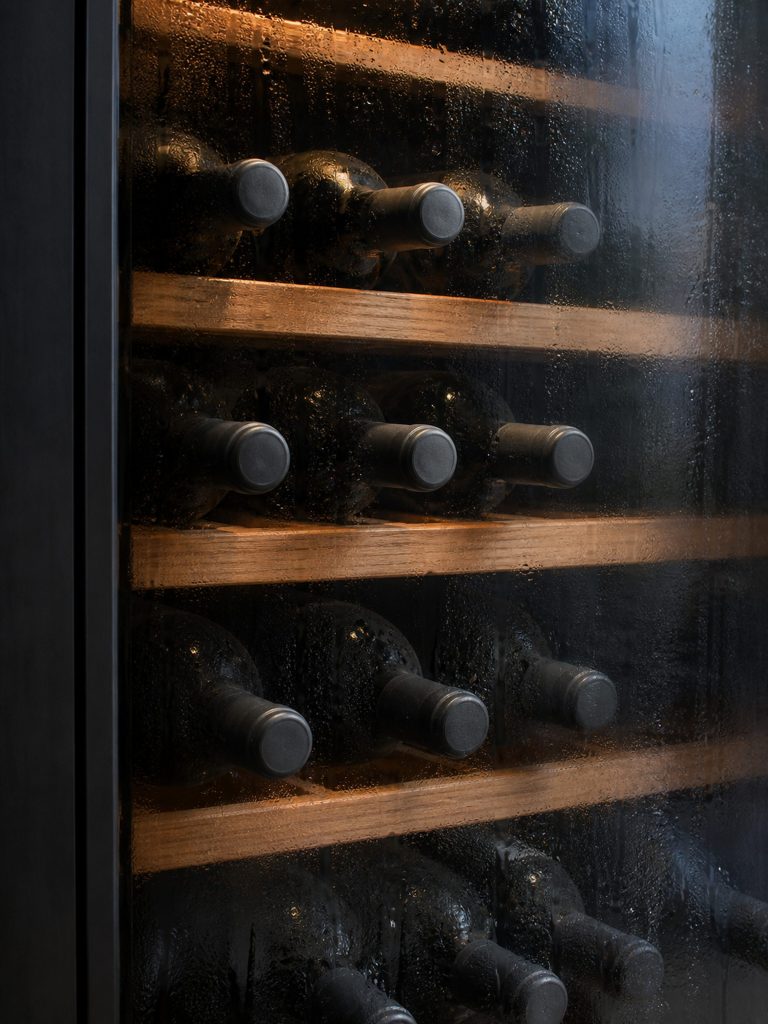
  • Wine bottles lying on wooden shelves behind smoked glass, the inside of the glass fogged with condensation
    One zone, or the whole cabinet

    Wine cooler not cooling

    The first question on a wine cabinet is not what has failed but how much of it. Five of these models hold two zones independently, and a single zone drifting is a much smaller job than the phrase "the wine cooler has failed" suggests.

    • One zone warm, the other right
    • The whole cabinet drifting
    • Bottles warmer than the display claims
    What it usually means
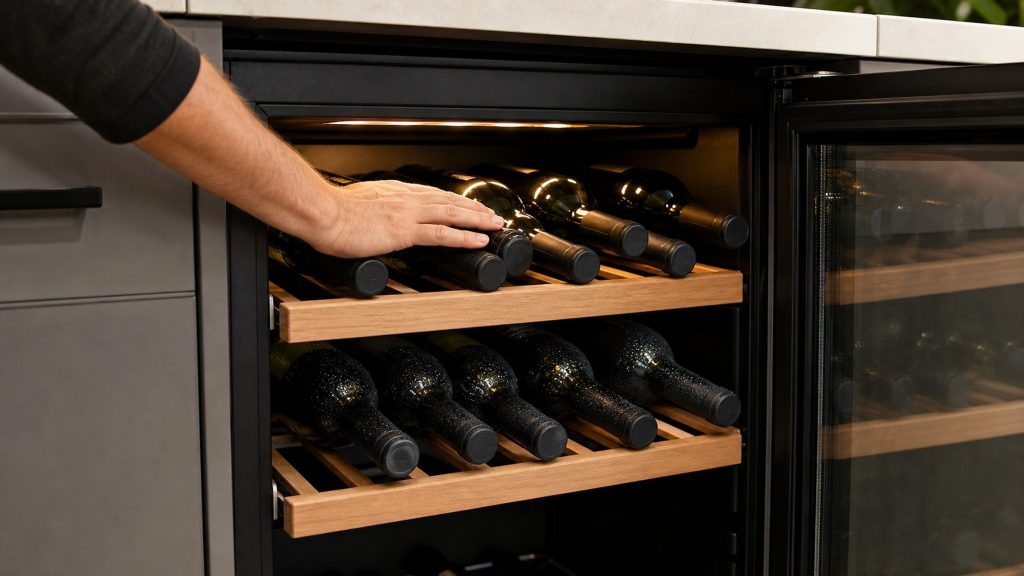
  • An undercounter wine cabinet with its glass door open and two wooden shelves drawn out — the upper bottles dry and warm-lit, the lower ones running with condensation
    A cabinet that shows nothing at all

    Wine cooler will not turn on

    A dark cabinet is not necessarily a dead one. On this make two settings blank the display completely while the appliance carries on working, and both are enabled by holding a button somebody leaned on.

    • Display blank
    • No light, no sound, no display
    • Cabinet still cold inside
    What it usually means
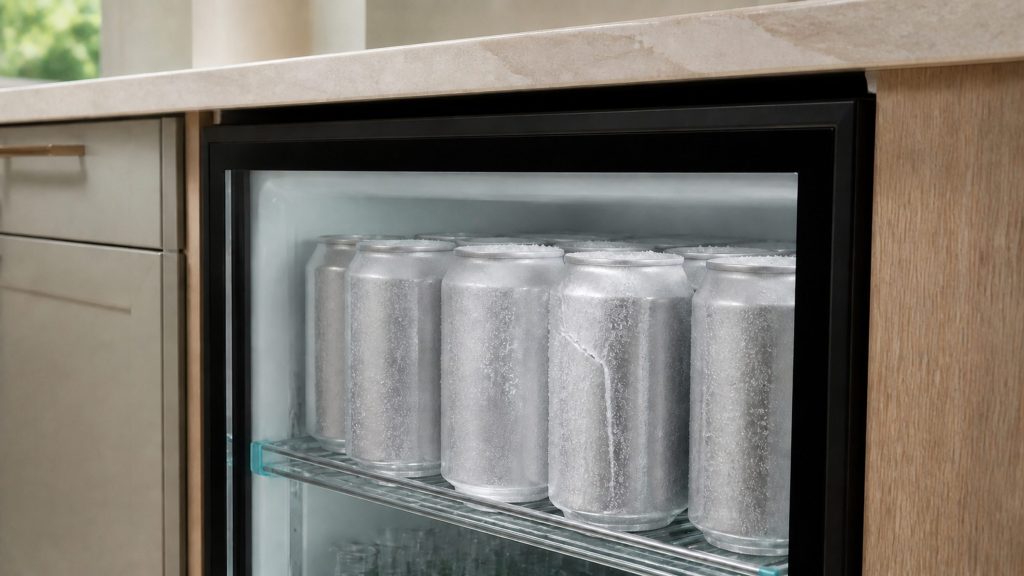
  • Cans standing on the lit shelf of a glass-fronted beverage cabinet with a rime of ice crystals across their tops and a burst seam on one of them, water frozen in a bead down its side.
    Too cold is a failure too

    It is freezing what is inside it

    Frozen cans, a slushy bottle, or ice forming on the back wall of something that should never freeze. On this control that is a short list, and one item on it is not a failure at all.

    • Cans freezing at the back
    • Bottles slushy in the morning
    • Ice forming on the rear wall
    What it usually means

If your number is not here

Not every U-Line number is published, and we will not invent the rest.

Fifteen numbers and eleven signals, every one traceable to a manual. The current Home and Seamless collections keep an error log the maker points at an appendix for — and that appendix is not in the document. Where that is the answer we say so, because this is the brand whose codes were invented wholesale once already.

Before you book

The questions this page is asked

Why can I not find my code anywhere online?

Because most U-Line numbers are never displayed. The control logs fifteen of them and shows one — the door. The rest live in a service menu behind a hidden key. If you are looking at a bare number on an ice machine it is probably 11, 12 or 13, which the maker prints as E11, E12 and E13 and notes are displayed as digits.

What are HTA and PF?

Not U-Line codes. They trace to Frigidaire and Electrolux documentation and appear in none of the forty-four U-Line manuals read for this site. HH is in the same position: people search for it and no U-Line manual prints it. None of the three is published here.

My unit is a current Home or Seamless model and the manual points at an Appendix D.

And that appendix is not in the document. Those controls keep a real error log — the service menu has an option for it — and the maker does not decode it in print. We are not going to invent the meanings, so on those machines the diagnosis is the log plus measurements.

How do I read the error log myself?

Hold the hidden button for ten seconds to enter the service mode; the display shows 0. The log is option 14 on the older controls and 21 on the current ones, and the errors scroll in the order they happened. Please write them down before clearing anything — the sequence is most of what a technician can work with.

Is a signal less serious than a code?

Not necessarily, and sometimes the reverse. Self Preservation Mode shows nothing at all and means a sensor has failed. Showroom mode shows a flashing symbol and means nothing is wrong. What matters is what the appliance is doing, not whether it has a number attached.

In more detail

Fifteen numbers, eleven signals, and one honest caveat

Every entry in this archive is traceable to a User Guide & Service Manual downloaded from U-Line’s own site. The text of forty-four of them is archived in this project, and each page names the document and the section its wording came from. That matters more on this make than on any other in this fleet, because U-Line is the brand whose codes were invented wholesale once already: a sibling network published about 38 “codes” that were plain-English symptoms.

Ten of the fifteen numbers here are claimed by a real model’s own service menu — the doors, the thermistors, the second door and the drain pump. Five of them — E4, E8, E11, E12 and E13 — appear on the control board’s printed list and in no model’s own menu among the manuals we read. They are published anyway, because 11, 12 and 13 are among the most searched things about this make and people type them as bare digits, which is exactly what the maker’s own “displayed as 11” predicts. Their pages say where they come from rather than implying they apply to your machine.

The eleven signals carry the rest, and on this appliance that is most of the work. A mode that stops the cooling while the light works. A backup mode that hides a dead sensor behind a fixed cycle. A cleaning request made with three lamps. A padlock on a panel that is not broken. Each is quoted, each is labeled a signal rather than a code, and each links to the repair it usually becomes.

What is not here: HTA, PF and HH, which belong to other makers or to nobody; decoded meanings for the current Home and Seamless collections, whose manuals point at an appendix that does not exist; and any number that could not be quoted from a document.
Have a number, or just a behavior?

Either is useful. Photograph the display, note the model, and tell us what the appliance is doing — on this make the second is often worth more than the first.

This article is based on:

  • Official manufacturer documentation
  • Internal repair procedures
  • Technician repair history
  • Company quality standards
Call (305) 851-2207